PSF Modeling
After a star is detected and its HFR measured, Hocus Focus can fit an analytic Point Spread Function (PSF) to the star's pixels. The PSF fit is what produces a star's FWHM (full width at half maximum) and eccentricity; without it those metrics are unavailable. This page covers the settings that control whether PSF fitting runs, which model is used, how finely it samples, and the goodness-of-fit gate that decides whether a fit is trusted.
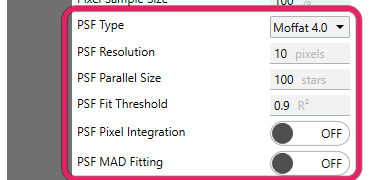
The PSF modeling block: model type, resolution, parallel batch size, and fit threshold.
These settings live under the Advanced star-detection options. They do not affect star acceptance (which stars pass the acceptance gates). They only affect the per-star shape measurement that PSF fitting produces.
What PSF modeling does
Star detection first finds candidates, measures each star's centroid and HFR, and applies the acceptance gates. If PSF modeling is enabled, every accepted star then gets an analytic profile fit on top of that. The fit is solved per star, optionally across parallel batches, and is accepted only if its goodness of fit (R²) clears a threshold. A star whose PSF fit fails the threshold keeps its HFR but reports no FWHM/eccentricity (and increments the PSFFitFailed metric). HFR itself never depends on these settings; see Half-Flux Radius below.
Settings at a glance
| Setting | Default | Range | Effect |
|---|---|---|---|
| Fit PSF | On | On / Off | Master switch for fitting PSFs; required for FWHM and eccentricity |
| PSF Type | Moffat 4.0 | Gaussian, Moffat 4.0 / 2.5 / 1.5, Moffat (β fittable) | Which analytic profile is fit to each star |
| PSF Resolution | 10 | integer > 0 (pixels) | Sampling-grid width across the star box; accuracy vs. speed |
| PSF Fit Threshold | 0.9 | (0, 1] (R²) | Minimum R² for a fit to be accepted |
| PSF Pixel Integration | Off | On / Off | Integrate the model over each pixel instead of point-sampling |
| PSF MAD Fitting | Off | On / Off | Experimental absolute-deviation fit, more robust to noise/outliers |
| PSF Parallel Size | 100 | integer ≥ 0 (stars) | Batch size for parallel fitting; 0 disables parallelism |
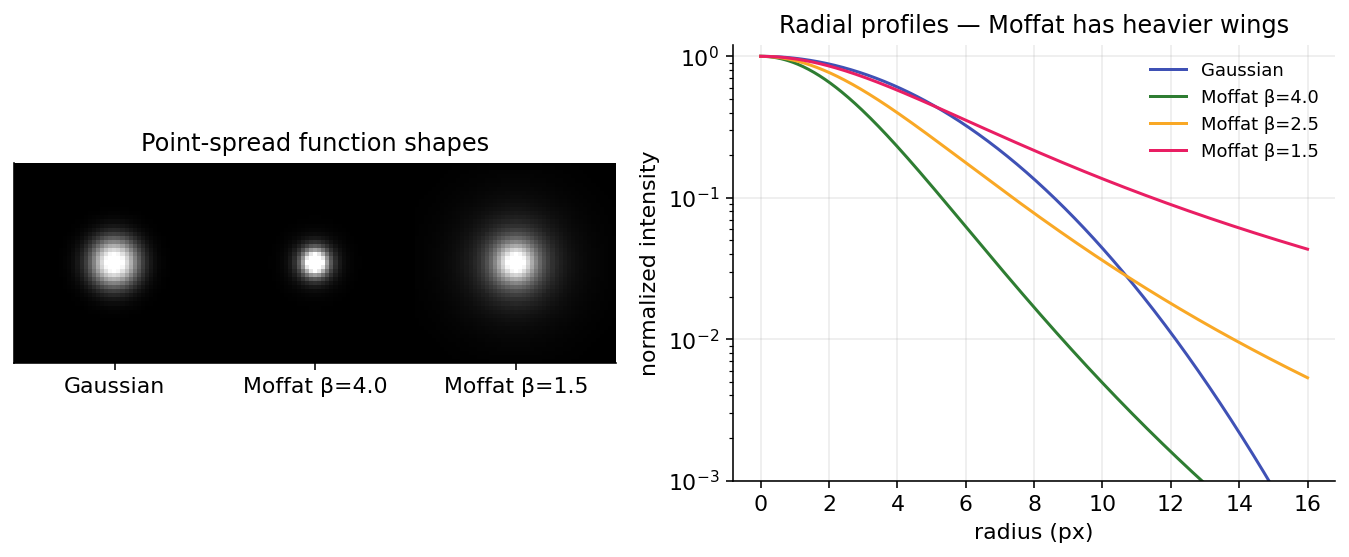 Gaussian (light wings) versus Moffat (heavier wings) profiles. Real stars carry more flux in the wings than a Gaussian predicts, which is why a Moffat model is the default.
Fit PSF
Fit PSF (property ModelPSF) is the master switch that turns PSF fitting on or off for detected stars.
Whether to fit PSF models to detected stars. This is required for FWHM and Eccentricity
Default: On • Range: On / Off
When this is on, each accepted star is fit and the results populate the star's FWHM and eccentricity. When off, the detector skips fitting entirely and those metrics are unavailable; HFR is still measured.
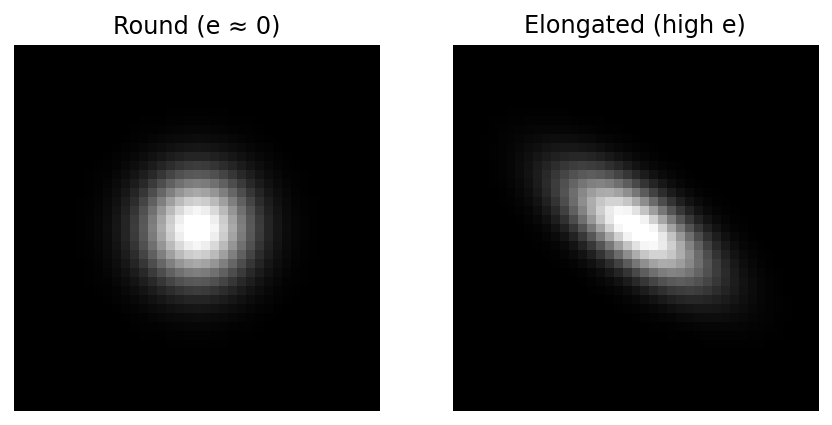 Eccentricity measures how elongated a star is: a round star (left) has eccentricity near 0, while an elongated one (right), from tilt, trailing, or astigmatism, has high eccentricity. This shape comes only from the fitted PSF.
When this helps
Leave it on for aberration inspection, tilt analysis, eccentricity maps, and any workflow that reads FWHM/eccentricity. Turn it off only when you need the lightest, fastest detection and care solely about star counts and HFR; the cost is per-star fit time, which grows on dense fields. Auto-focus runs already force PSF modeling off internally for speed, so this switch mainly affects the detection-driven analysis panels.
PSF Type
PSF Type (property PSFFitType) selects which analytic profile is fit to each star.
What type of PSF model to fit. Moffat 0.4 more closely resembles real stars and is the default used by PixInsight
Default: Moffat 4.0 • Range: Gaussian, Moffat 4.0, Moffat 2.5, Moffat 1.5, Moffat (β fittable)
A Gaussian falls off quickly and underestimates the light in a star's wings. A Moffat profile adds heavier wings governed by a power-law exponent \( \beta \), which is why it tracks real stellar profiles more faithfully. The numeric labels are fixed \( \beta \) values:
- Moffat 4.0 — moderate wings; the default and PixInsight's default.
- Moffat 2.5 / 1.5 — progressively heavier wings (smaller \( \beta \) = more flux far from the core).
- Moffat (β fittable) — lets the solver fit \( \beta \) per star instead of fixing it.
- Gaussian — the limiting light-wing case; fastest but least faithful to real PSFs.
When this helps
Leave it at Moffat 4.0 for general use. Try a heavier-wing Moffat or the fittable-β variant if your optics produce pronounced wings or halos and fixed-β fits are clearing the R² gate poorly. Gaussian is mainly useful as a fast baseline or for comparison.
PSF Resolution
How finely each star's bounding box is sampled when fitting the model.
The number of pixels of the width of a nominal square to sample star bounding boxes for the purposes of PSF model fitting. Higher resolution may be more accurate, but takes longer to calculate
Default: 10 (pixels) • Range: integer > 0 (the field validates greater-than-zero; the backing property rejects negatives)
Higher resolution gives the solver more samples per star (potentially a more accurate fit) at the cost of compute time per star.
When this helps
The default of 10 is a good balance. Raise it if FWHM/eccentricity look noisy on large, well-sampled stars and you can spare the time; lower it to speed up fitting when you have many stars and accuracy is non-critical. It does not change which stars are accepted.
PSF Fit Threshold
The R² goodness-of-fit gate that decides whether a PSF fit is trustworthy.
The minimum goodness of fit (R²) required for a PSF
Default: 0.9 (R²) • Range: greater than 0 and at most 1.0 (the field accepts 0 through 1.0; the backing property rejects 0 and anything above 1.0)
After a star is fit, its coefficient of determination \( R^2 \) is compared against this threshold. A fit with \( R^2 \ge \) threshold is kept; otherwise the fit is discarded (the star keeps its HFR but reports no FWHM/eccentricity, and the PSFFitFailed count increases). \( R^2 = 1 \) is a perfect fit; lower values mean the model explains less of the star's pixel variance.
When this helps
Keep 0.9 for clean, well-fit metrics. Lower it (e.g. toward 0.8) if too many real stars are getting no FWHM because their fits fall just short, common for noisy frames or unusual profiles. Raise it toward 1.0 to admit only near-perfect fits when you want the cleanest possible shape statistics and can afford fewer measured stars.
Warning
A very low threshold lets poorly-fit stars through with unreliable FWHM/eccentricity; a very high one can leave most stars with no shape metrics at all.
PSF Pixel Integration
Computes the model value for each pixel as the integral over the pixel's area rather than a single point sample at the pixel center.
When enabled, PSF model values are computed as the integral over the pixel area rather than sampled at the pixel centre. Reduces sigma error on undersampled rigs (FWHM ≈ 1.5 px) from ~8% to less than 5%. Leave off for well-sampled rigs.
Default: Off • Range: On / Off
Point-sampling the model at \( (i, j) \) ignores how the profile varies across a pixel. On undersampled rigs (where a star spans only a couple of pixels) that approximation biases the fitted sigma. Integrating the model over each pixel area \([i-0.5, i+0.5]\times[j-0.5, j+0.5]\) removes most of that bias.
When this helps
Turn it on for undersampled setups (short focal length / large pixels, FWHM around 1.5 px), where it cuts sigma error from roughly 8% to under 5%. Leave it off for well-sampled rigs. The extra cost buys nothing there. To judge it, compare reported FWHM/σ stability before and after, and watch the PSF Failed count in the Star Detection Results panel for any change in fit rejections.
PSF MAD Fitting
PSF MAD Fitting (property UsePSFAbsoluteDeviation) is an experimental fitting mode that minimizes absolute deviation instead of squared residuals.
Enables an experimental PSF fitting approach that is more robust to noise and outlier pixels. This should more closely mimic PixInsight PSF fitting logic
Default: Off • Range: On / Off
Fitting to minimize absolute deviation downweights outlier pixels (a hot pixel, a cosmic-ray hit, a nearby star's flux) relative to a least-squares fit, at a modest extra computational cost.
When this helps
Try it on noisy frames or fields with frequent outlier pixels where ordinary fits are being pulled around, and when you want behavior closer to PixInsight's PSF logic. Judge it the same way as PSF Pixel Integration above: FWHM/σ stability before and after, plus the PSF Failed count. Because it is experimental and slower, leave it off by default and enable it deliberately when robustness matters more than speed.
PSF Parallel Size
Batches stars for parallel PSF fitting.
Enables parallel processing of PSF modeling by partitioning the detected stars into batches of this size. Set to 0 to disable parallelism
Default: 100 (stars) • Range: integer ≥ 0 (the backing property rejects negatives)
Stars are partitioned into batches of this size and each batch is fit on its own task, which speeds up frames with many stars on multi-core machines. A value of 0 disables parallelism and fits every star sequentially.
When this helps
Leave it at 100. Set it to 0 only when debugging or when you need strictly sequential, deterministic ordering. It is a pure performance knob. It does not change which stars are accepted or the fitted values.
Half-Flux Radius (HFR)
HFR is the workhorse focus metric and is measured for every accepted star regardless of the PSF settings above. It is the flux-weighted mean radius of a star's light over a circular aperture, computed with per-pixel local-background subtraction: each pixel's distance from the centroid is weighted by its background-subtracted flux. A tighter, better-focused star has a smaller HFR, and a bloated, defocused star a larger one.
where \( f_i \) is the background-subtracted flux of pixel \( i \) and \( r_i \) is its distance from the centroid.
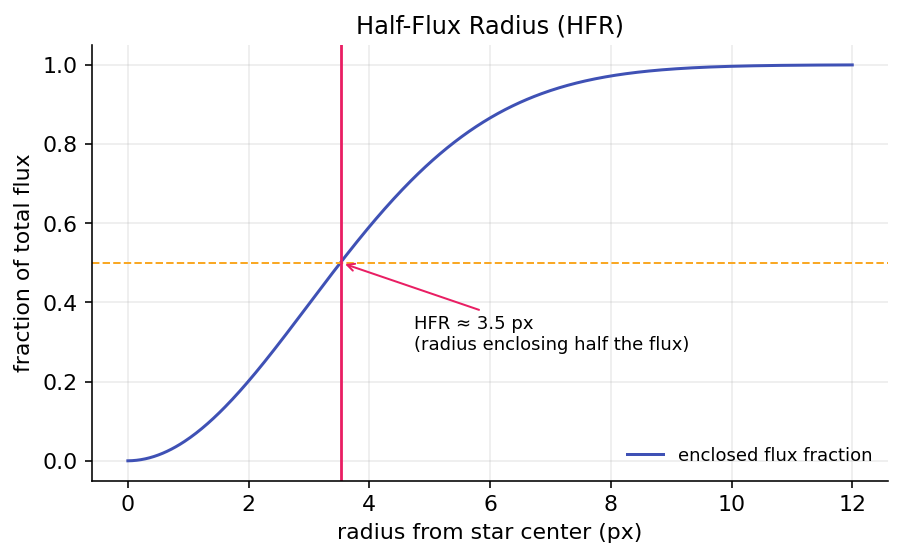 The classic construction the name "half-flux radius" comes from: the aperture radius enclosing half the star's
total flux. Hocus Focus does not measure it this way — it computes the flux-weighted mean radius above, which
tracks the same thing (tight star, small value; bloated star, large value) but is cheaper and more robust on
faint stars.
Note
HFR is the value auto-focus minimizes to find best focus, and the per-star metric the detector reports even when ModelPSF is off. FWHM (from the PSF fit) is a related but distinct measurement of profile width; the two are not interchangeable. For how HFR feeds the focus curve, see Auto-Focus.