Search Algorithm
The optimizer that powers the Star Detection Optimization Wizard does not use a smooth solver like gradient descent or Nelder–Mead. The star-detection objective is piecewise-constant: detection counts stars crossing thresholds, so the score jumps as stars enter or leave the accepted set, and gradients are undefined. A smooth solver would chase that quantization noise. Instead the optimizer runs a deterministic, derivative-free, memoized staged compass (pattern) search: it probes each axis by fixed steps, keeps only strictly-improving moves, and shrinks the steps as it homes in.
This page describes how the search moves. The score it maximizes is on Objective function; the knobs it is allowed to move and their bounds are on Search variables.
Where this lives
The engine is StarDetectionOptimizer.OptimizeAsync. It is a pure function over an injected
evaluator delegate (candidate parameters → per-run metrics): it never loads images, runs
detection, or touches the UI. The same engine drives the live wizard and the offline TestApp
optimize harness.
Three guarantees
These three properties hold for every run of the search.
- Deterministic. There is no random number generator. The seed is read from a fixed starting
vector: by default the default detection parameters, or your current settings when you
choose "Start from my current settings". Axes are visited in a fixed curated order, and the two
probe directions are always tried
+then−. Detection and the curve fit are themselves deterministic, so the same inputs always produce the same optimized result. - Never-regress. The seed is the initial incumbent and the floor: only strictly-improving moves are ever accepted (ties move nothing), so the optimized result can never score worse than the seed. The wizard layers one more guarantee on top. It compares the result against your current settings and will not hand back anything worse than them, so the worst case is "no change." (When you start from current settings, the two floors coincide.)
- Memoized. Every candidate is keyed on
StarDetector.ComputeCacheKey. A point the search revisits is served from a cache and never re-invokes the expensive evaluator. The evaluation budget counts only cache misses.
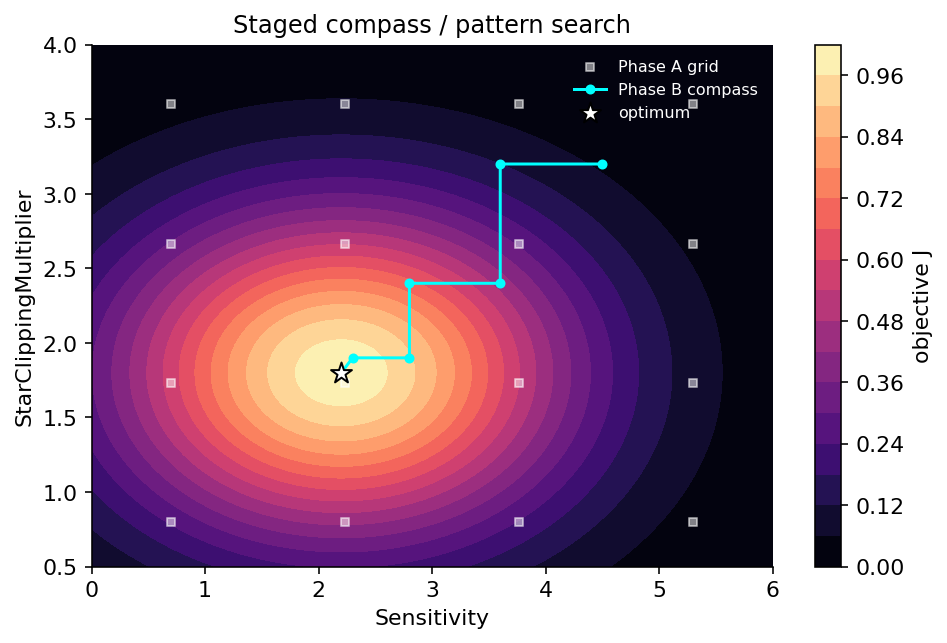
The compass search starts at the seed, probes each axis by \(\pm\)step, steps to the best improving neighbor, and halves the step when a sweep finds nothing, converging on a local optimum.
The search, end to end
The run proceeds in two phases after the seed is scored.
Seed
Each variable is read from the seed parameters (the default settings, or your current settings if you chose to start from them) and quantized to a legal value (integers rounded, booleans thresholded at 0.5). That vector is evaluated once. Its score, \(J_{\text{seed}}\), is both the starting incumbent and the never-regress floor.
Phase A — coarse grid
Detection has two basins that a local search alone can get stuck between: a "few bright stars" basin
and a "many faint stars" basin. Phase A escapes a bad starting basin with a coarse grid over the
two highest-impact axes, Sensitivity × StarClippingMultiplier. It evaluates a
CoarseGridLevels-by-CoarseGridLevels grid (default 4×4 = 16 points), with every other variable
held at the incumbent. The levels are evenly spaced and inclusive of both bounds: level 0 is the
lower bound, the last level is the upper bound. The best strictly-improving grid point becomes the
new incumbent; if none beats the seed, the incumbent is unchanged.
Why these two axes
Sensitivity and StarClippingMultiplier are the two knobs that most strongly control how many
candidates survive into the accepted set, so they define the basin. Gridding them first means the
finer Phase-B search starts from a sensible region instead of refining a poor one.
Phase B — staged compass search
Phase B refines the incumbent with a compass search, but it stages that search so it stays fast. The curated axes are partitioned into two groups by their effect on the detection pipeline:
| Group | What a move does | Members |
|---|---|---|
| EARLY | Forces a full re-detect: rebuilds and evicts the cached per-frame detection context (the expensive wavelet / binarization / candidate-collection stage) | HotpixelThresholdingEnabled, HotpixelThreshold, NoiseReductionRadius, NoiseClippingMultiplier, StructureLayers, DefocusAwareStructure, and DonutMorphCloseSize when donut recovery is on (plus internal context keys such as the saturation threshold and region) |
| LATE | Re-runs only the cheap gate-and-measure step against an already-built context (a cache hit) | everything else: the gate/measure knobs and the synthetic DefocusAwareGates switch |
Each stage is itself a full compass over its subset:
- From the incumbent, propose
±stepon every axis in the subset (integers:±max(1, round(step)); booleans: a single flip; continuous:±step), in the subset's fixed order. - Evaluate them all and accept the single best strictly-improving move, then re-sweep from there.
- A sweep that finds no improving move halves every continuous step in the subset and sweeps again.
- The stage ends when all continuous steps fall below their floor (
StepFloorFraction × InitialStep, withStepFloorFraction = 0.125, one-eighth of the starting step), or, for an all-discrete subset, when a sweep finds no improving move, or when the budget is exhausted.
The two stages alternate in an outer loop:
- LATE stage runs first and refines cheaply with the early parameters pinned, so every late probe is a per-frame cache hit.
- EARLY stage then runs one bounded compass over the early axes. The next late stage refines from the rebuilt-once early context, again via cache hits.
- The outer loop repeats LATE → EARLY while a full round improves and budget remains. The early stage is permanently skipped once an early stage yields no improvement, so the expensive axes are not re-probed indefinitely; the loop then stops as soon as a late-only round can no longer improve.
Staging changes the order, not the result
Splitting the axes into LATE and EARLY subsets only changes which order candidates are visited, not which points are reachable. With no early axes the early stage is a no-op (pure late search); with no late axes the late stage is a no-op (pure early search). The never-regress and determinism guarantees hold regardless.
Convergence and the budget
A continuous axis halves its step each fruitless sweep (InitialStep, then a half, a quarter, and an
eighth) until the step falls below the 0.125 × InitialStep floor. Each axis therefore works through
four step sizes, coarse to fine, and then stops; the search terminates rather than oscillating on
quantization noise.
Two hard stops bound the work:
- The step floor ends each compass stage once every continuous step is below its floor (and an all-discrete subset ends as soon as a sweep finds nothing).
- The evaluation budget,
MaxEvaluations = 250by default (raised to 400 when Recover out-of-focus donut stars is enabled, since that unlocks extra defocus axes to explore; overridable in the harness via--max-evals), caps the number of distinct candidate evaluations. The search never starts an evaluation past the cap. Because of memoization, revisited candidates do not count against it.
What a single evaluation costs
One evaluation scores a candidate against the run the wizard is optimizing. The evaluator
(RunEvaluationData):
- Detects every frame in the run, concurrently but capped (default \(\approx \max(2, \text{ProcessorCount}/4)\) frames in flight) to fill idle cores during the largely single-threaded early stage without exhausting memory. Results are assembled by frame index, so the outcome is identical to a sequential loop regardless of how the frames interleave.
- Pools frames that share a focuser position into one scatter point (mean HFR, SEM-pooled error), matching the autofocus engine's averaging.
- Fits the focus curve with your run's actual AF fit settings, requiring at least
MinPositionsForFit = 3distinct focuser positions; too few yields a NaN focus σ and the objective hard-fails that run to a score of 0. - Reads the fit metrics off the winning fit: \(\sigma_{\text{focus}}\), \(R^2\), and reduced \(\chi^2\), plus recall and precision when labels exist.
These metrics feed the composite objective \(J\) for the run (see Objective function).
The early-context cache — why staging matters
Detection compute dominates wall-clock: a full-frame wavelet plus binarization-statistics plus
gate-and-measure pass. The detector is split into a cacheable EARLY phase (depends only on the
early parameters, ~78% of a detection) and a cheap LATE phase (the gate/measure step, ~22%).
RunEvaluationData caches the early context per (frame, early-key) and reuses it across candidates
that change only late-stage gates, which is the bulk of a compass search. This is exactly why the
LATE stage runs first and pins the early parameters: those probes are all cache hits.
The cache is bounded to one context per frame (the current early key); when a frame's early key changes the prior context is disposed before a new one is built (at 61 MP each context pins roughly 244 MB). The split is value-preserving (detection output is bit-identical to the uncached path), so the speedup is free. Measured end to end, the early/late split plus bounded parallelism delivers ~10–13× faster optimization on real AF banks.
What the wizard shows while it searches
Because a cache-hit probe and a context-rebuilding probe differ by one to two orders of magnitude, and the search runs them in blocks, the progress panel names which kind it is on. During a rebuild the heading reads "slow step (re-analyzing every frame)" and a second line counts the frames of the evaluation in flight, so a search that has not moved its evaluation counter for several minutes is still visibly working.
The panel does not project a finishing time while the search still has early axes to move. The remaining cost depends on how many more early stages run, which is decided by whether the landscape keeps improving, so no honest bound exists. The line reports the measured cost of each kind of step and how many steps remain in the budget, and leaves it there. A search over a purely late variable set does have a uniform step cost, and there the panel still shows an upper bound on the time left.
Reading the result
OptimizeAsync returns the best parameters, \(J_{\text{seed}}\) and \(J_{\text{best}}\), the
number of evaluations spent, an ImprovedOverSeed flag (true only when \(J_{\text{best}} >
J_{\text{seed}}\)), and a ChangedVariables list: every axis whose optimized value differs from
the seed, with both values. The wizard summary surfaces exactly these changes, so every move the
search made is reversible and auditable.
Step-size recommendation
The recommended autofocus step size is derived from the winning fit, not searched: it is not one of the optimizer's variables. From the fitted curve, the recommender finds the focus-sensitive half-width \(W\): the offset from best focus at which the modeled HFR reaches three times the minimum HFR (averaged over the two sides to handle an asymmetric model). It then sets the step to \(W / 3.5\), so a sweep lands roughly 3–4 measurement points per side inside the band where the curve carries the most slope, with a default of 4 offset steps per side. The result is clamped to at least 1 and, when supplied, to the focuser's maximum step. A degenerate fit returns your current step size unchanged.
See Step-size recommendation for the full derivation and figure.
It applies to future runs
A replayed sweep cannot be re-sampled at a new spacing, so the recommended step is advice for your next run. The wizard writes it to your profile only when you confirm.