From Focus Frames to a Score
The Star Detection Optimization Wizard does not score your settings on a single image. It scores them on a whole autofocus run, a sweep of frames taken across a range of focuser positions. For each candidate set of detection parameters, the wizard detects stars on every frame, rebuilds the HFR-vs-focuser curve those frames imply, fits it, and reads how repeatable and trustworthy the resulting best-focus estimate is. That single number is what the search maximizes.
This page walks the pipeline end to end: detect → aggregate per frame → pool by focuser position → fit the curve → read \(\sigma_{\text{focus}}\), \(R^2\), reduced \(\chi^2\) → fold those into the objective's focus and curve-fit terms. For the full objective (all sub-scores and weights) see the objective function; for how the search moves through the parameter space see the search algorithm.
The pipeline at a glance
The work for one candidate parameter bundle, on one run, is done by RunEvaluationData:
- Detect every frame. Run the real HocusFocus star detector on each saved exposure with the candidate parameters, producing for that frame an average HFR, an HFR standard deviation, and an accepted-star count.
- Pool frames that share a focuser position. AF runs often capture more than one exposure at the same focuser step; those are merged into a single curve point with a pooled error bar.
- Fit the focus curve. With at least 3 distinct focuser positions, fit the best of several models and read the minimum (best focus), its standard error \(\sigma_{\text{focus}}\), \(R^2\), and reduced \(\chi^2\).
- Score it. Feed \(\sigma_{\text{focus}}\), the star counts, \(R^2\), and reduced \(\chi^2\) into the objective's sub-scores.
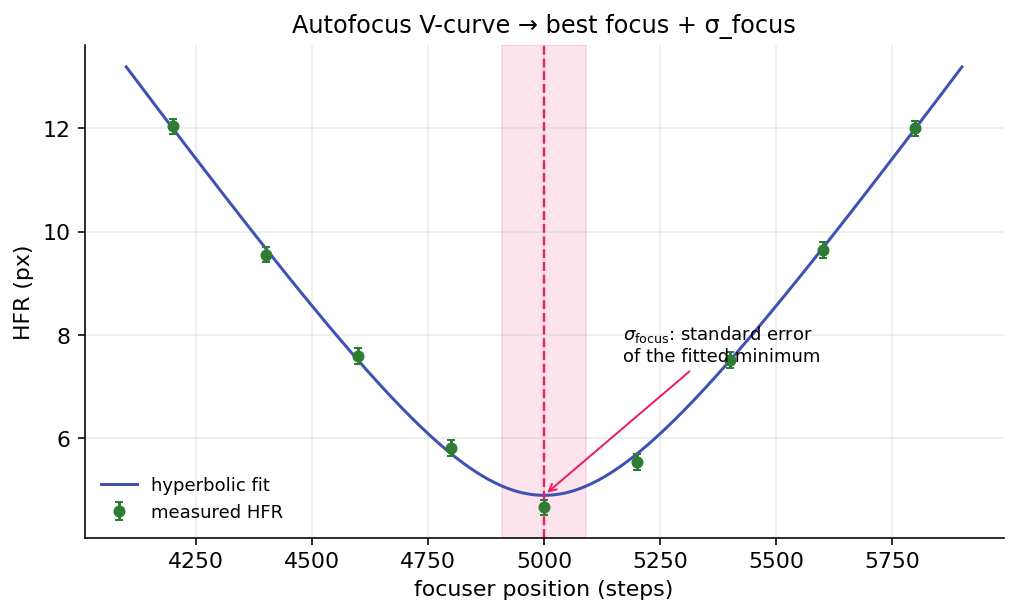
A run's pooled HFR points (one per focuser position, with error bars) and the fitted curve. The fit's minimum is the estimated best-focus position; the shaded band is \(\sigma_{\text{focus}}\), the standard error of that minimum. Better detection settings make the points tighter and the band narrower.
Note
The wizard loads each saved exposure once (rendered, no detection), then re-runs detection on the already-loaded frames for every candidate. The fit configuration (step size, weighting, outlier-rejection count and confidence) is taken from the run's own autofocus options, so the wizard's curve fit matches the autofocus engine's fit exactly. The optimizer is not changing how you focus; it is changing how cleanly the stars are measured.
Step 1 — detect, then aggregate each frame
For every frame, detection returns the average HFR of the accepted stars and the HFR standard deviation across them, plus the accepted-star count. HFR (Half-Flux Radius) is the radius that encloses half a star's flux, the standard size proxy that grows as a star defocuses.
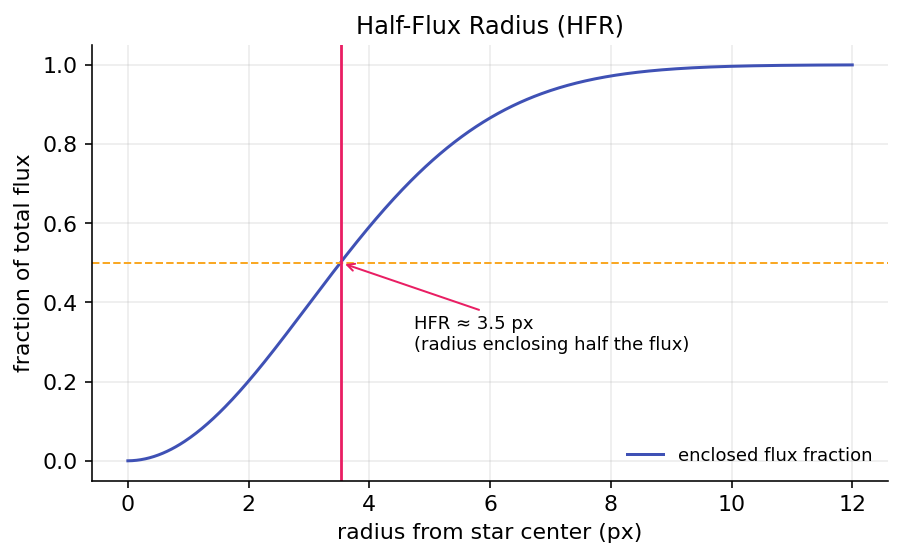
Half-Flux Radius: the radius at which the enclosed-flux curve reaches 50% of the star's total. It is the per-star size measure the focus curve is built from.
The accepted-star count matters on its own: the focus curve is only as reliable as the number of stars behind each point, and the defocused extremes of the sweep are where stars are biggest, dimmest, and most likely to drop out. A setting that detects plenty of stars near focus but starves the extremes produces a poorly-constrained curve, so the objective tracks the count per frame as well as the resulting fit (see the star-count term, \(S_{\text{stars}}\), in the objective function).
Step 2 — pool frames at the same focuser position
Frames captured at the same focuser position are merged into one curve point using the same semantics as the autofocus engine: the point's HFR is the mean of the per-frame measures, and its error bar is the SEM-pooled standard deviation: the per-frame \(\sigma\)s combined and divided by the square root of the number of contributing frames. Iterating in ascending focuser position keeps the fit input deterministic. The result is one scatter point (focuser position, pooled HFR, pooled error) per distinct focuser position.
Step 3 — fit the focus curve
With at least 3 distinct focuser positions, the wizard runs the same "best fit" model selection
the autofocus engine uses (AlglibHyperbolicFitting.SelectBestModel): it tries the candidate models
and picks the winner on merit, rather than forcing a single shape (see
Hyperbolic Curve Fitting for the model family and the Hybrid
selection rules). From the winning fit it reads:
| Quantity | Meaning |
|---|---|
| Best-focus position | The fitted curve minimum (the focuser position the run points at). |
| \(\sigma_{\text{focus}}\) | The standard error of the fitted minimum — how uncertain the best-focus estimate is, in focuser steps. |
| \(R^2\) | How well the model explains the pooled points. |
| Reduced \(\chi^2\) | Goodness of fit relative to the points' error bars. |
If \(\sigma_{\text{focus}}\) comes back non-finite (NaN or infinite), the wizard computes a leave-one-out best-focus standard error as a fallback, refitting with each point dropped in turn to estimate how much the minimum wanders. The objective prefers the parametric \(\sigma_{\text{focus}}\) and only pays for the leave-one-out fallback when the parametric value is unusable.
Warning
Fewer than 3 distinct focuser positions can never determine a fit (the hyperbola has 4–5 parameters). A run that thin produces a NaN \(\sigma\). The evaluation does not throw; the objective hard-fails the run to a score of 0. This is why a usable run needs a real sweep, not a couple of frames.
Step 4 — turn the fit into a score
Two of the objective's sub-scores read straight off this pipeline.
Focus repeatability — \(S_{\text{focus}}\)
The focus term rewards a best-focus estimate that is repeatable relative to the step size you sweep at. Define the normalized uncertainty \(\rho = \sigma_{\text{focus}} / \text{stepSize}\) (using the leave-one-out value when \(\sigma_{\text{focus}}\) is non-finite), then
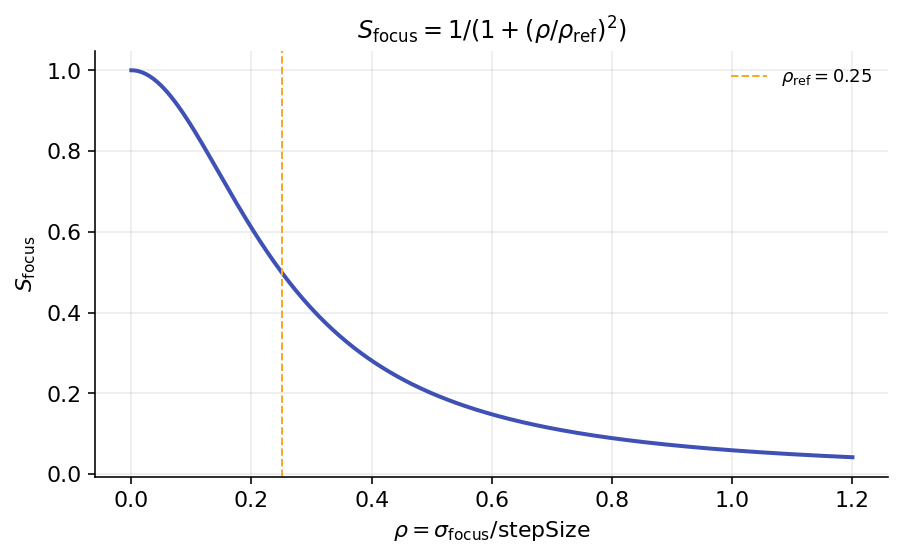
\(S_{\text{focus}}\) is monotone-decreasing in \(\rho\): a best-focus estimate uncertain by a quarter of a step (\(\rho = \rho_{\text{ref}}\)) scores 0.5; sharper scores higher, fuzzier lower. If neither \(\sigma_{\text{focus}}\) nor the leave-one-out fallback is finite, the run hard-fails to 0.
Normalizing by step size is deliberate: an uncertainty of "a few focuser steps" means something very different on a fine-stepping focuser than on a coarse one. \(S_{\text{focus}}\) carries the largest weight in the objective, because a tighter best-focus position is the entire point of the exercise.
Curve consistency — \(S_{\text{fit}}\)
The curve-fit term rewards a model that actually explains the points without being contradicted by their error bars:
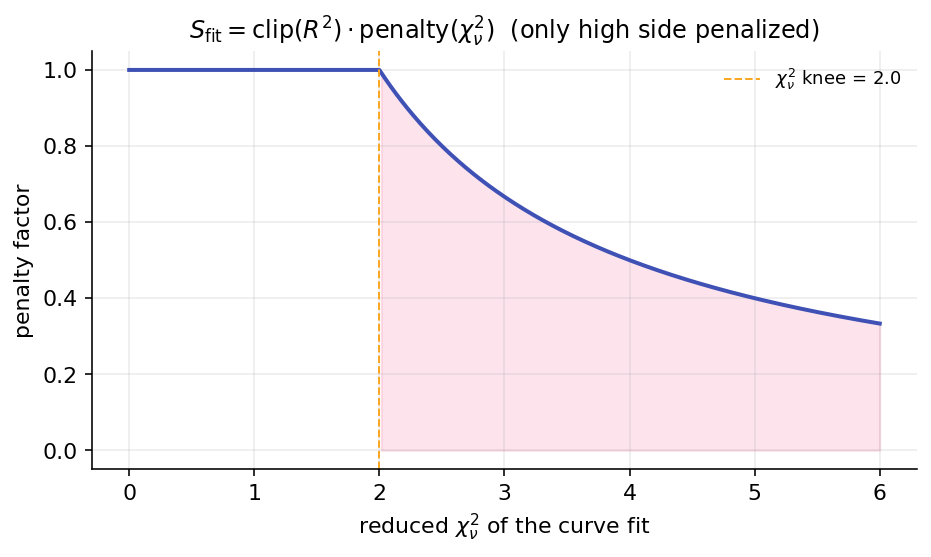
Only the high side of reduced \(\chi^2\) is penalized. Star-rich fields routinely produce a reduced \(\chi^2\) well below 1 (over-fit-looking but benign), so values at or below the knee \(\chi_\tau = 2.0\) carry no penalty at all; above the knee the penalty decays smoothly as \(\chi_\tau / \text{reduced }\chi^2\).
The star-count sub-score \(S_{\text{stars}}\) draws on the per-frame accepted counts from Step 1 rather than the fit; it is covered alongside the full weighting in the objective function.
A byproduct: the recommended step size
The same winning fit also drives the wizard's step-size recommendation, which is reported (and applied on confirm) but is not part of the score. The idea is to size the autofocus step so a sweep lands roughly 3–4 measurement points on each side of focus inside the "focus-sensitive" band, the region where HFR climbs from its minimum to about three times the minimum, which carries the most slope and therefore the most information.
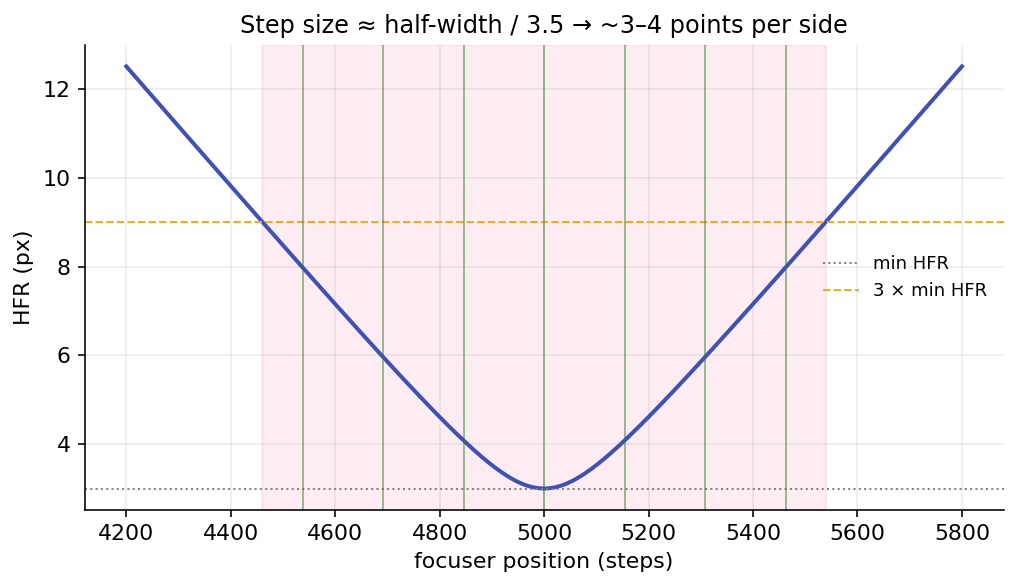
The wizard reads the half-width \(W\) (the offset from best focus at which the fitted HFR reaches \(3 \times\) the minimum HFR, averaged over the two sides) and recommends a step of \(W / 3.5\), so the focus-sensitive band holds about 3–4 points per side. The recommendation defaults to 4 offset steps per side and is clamped to at least 1 (and to the focuser's limits when known).
See Step-size recommendation for the full derivation.
A degenerate fit yields no usable half-width: no fit at all, a minimum that is not finite, or a non-positive minimum HFR. The wizard then leaves your current step size unchanged and marks the number as held rather than measured. A curve that never reaches three times the minimum within the bounded outward search from best focus is treated the same way only when the sweep cannot say whether the band was missed; when the sweep's own HFRs span less than three times their minimum, the band demonstrably was missed and the wizard widens the step to the most this sweep supports. The recommendation is most reliable when the fit is clean and the V-curve is well-formed, exactly the runs where the optimizer also scores high.
Note
A replay cannot re-sample your sky at a new spacing, so the step size is a recommendation for future runs, not a re-measurement of the one you replayed. It is written to your profile only when you apply the wizard's results.
How this scales to a budgeted search
This whole pipeline runs once per candidate, and the search tries hundreds of candidates (250 evaluations by default, raised to 400 when Recover out-of-focus donut stars is enabled). Two facts keep that affordable. First, detection is split into an expensive early stage (hot-pixel filtering, structure preparation, wavelet, binarization, candidate collection) and a cheap late stage (gate + measure); the early stage is cached per frame and reused whenever a candidate changes only late-stage gate parameters, which is the bulk of the search. Second, identical parameter bundles are memoized, so a revisited point never re-detects. The result is bit-identical scores at roughly 10–13× the speed.