Step-Size Recommendation
Once the optimizer has fitted a clean HFR-vs-focuser curve, it reads the curve's shape to recommend an autofocus step size. A step size that is too coarse skips over the focus-sensitive region and leaves you with two or three points to fit a curve through; one that is too fine wastes exposures crawling across focus. The recommender sizes the step so a sensible number of measurements land where the curve actually carries information.
The logic lives in StepSizeRecommender.cs and runs on the winning fit at the end of an optimization, so
the suggestion reflects detection settings that have already been tuned for your rig.
The focus-sensitive band
Far from focus the HFR curve is steep and almost linear; near the minimum it flattens. The band that matters for pinning the minimum is where HFR climbs from its minimum value up to roughly three times that minimum. The recommender measures the half-width of that band:
Starting from the fitted best-focus position, it searches outward in both directions for the offset at which the fitted HFR reaches \(3 \times \text{HFR}_{\min}\): a coarse outward walk brackets the target, then a bisection refines it to high precision. The search is bounded (at most a few times the sampled focuser span) so a flat or degenerate fit cannot send it off to infinity. The left and right offsets are averaged so an asymmetric model still yields a single half-width; if only one side reaches the target, that side is used on its own. If neither side reaches it, the recommender checks what the sweep itself measured: when the sweep's own HFRs span less than three times their minimum, the band demonstrably was never sampled, so it widens the half-width to the most this sweep supports rather than holding your current step. Holding would stall a too-shallow sweep for good, since the next run would sweep at that same step again. Only when the sweep cannot say either way does the recommender leave your step alone.
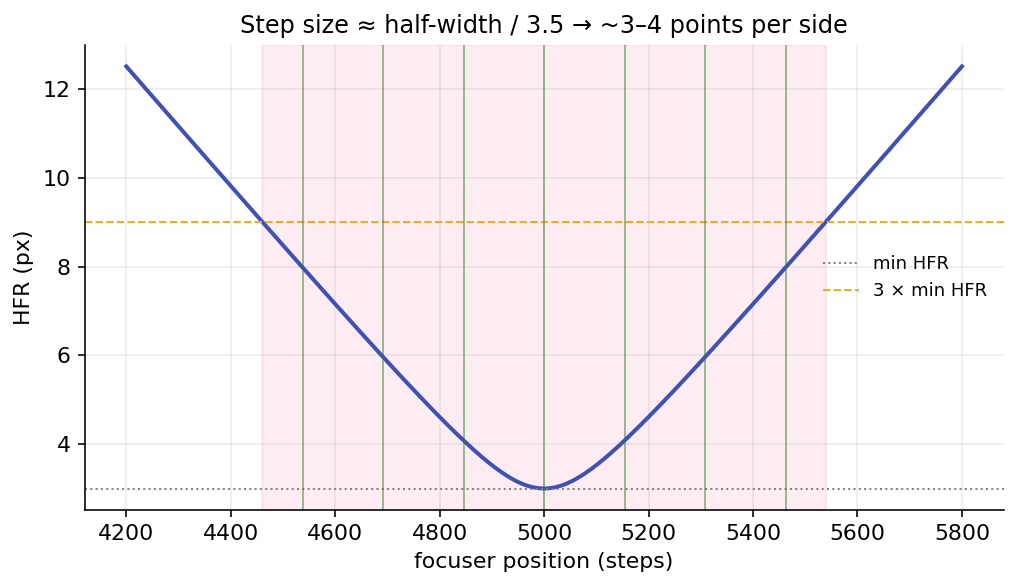 The shaded band spans the region where HFR is below three times its minimum. The recommended step (green lines)
divides each side of that band into roughly 3–4 measurement points.
From half-width to step size
The recommended step packs about 3.5 points per side of focus into the band:
The result is clamped to a minimum of 1 and, if a focuser maximum step is supplied, to that maximum. The recommendation is reported alongside a default offset of 4 steps per side, so an autofocus run sampling that many points on each side of the estimated minimum lands neatly inside the focus-sensitive region.
A sweep too narrow to contain the band is capped
The half-width is read off the fitted curve, so when the sweep is too shallow to reach three times the minimum HFR it comes from extrapolating the model past everything you measured. The shallower the sweep, the further out that lands: it can call for a sweep several times wider than anything measured, and even exceed the focuser's travel.
The half-width is therefore capped at 1.5× the sampled half-span, and the summary marks the recommendation as a partial step, naming how far this sweep reached and how fast it is converging: "14 → 24 (partial step: this sweep reaches 1.8× its minimum HFR and the step is sized from where HFR reaches 3×; each run widens by about 1.7× until it gets there; re-run auto-focus to refine)". The cap does not change where the recommendation converges, only how fast: each run widens the sweep, and a shallow rig reaches the same answer in about three runs. It only engages when the sweep's ends reach less than roughly 2.1× the minimum HFR; a well-shaped sweep is untouched.
Capping the half-width at 1.5× the sampled half-span bounds how far one run may widen the sweep; a second bound works in the other direction. The half-width is also limited by the outermost offset from focus at which an ordinary (non-recovery) frame still detected the hard floor of three stars, so a fitted band reaching past where this run could still see stars is pulled back toward what the sweep measured. The 3× band is pure curve geometry and asks nothing about whether stars are still visible out there; this bound is measured, so it can only ever report a distance the sweep actually visited. It only ever tightens, and it may not pull the half-width below half the sampled half-span in one run, so a sweep whose only star-bearing frames sit near focus roughly halves the step instead of collapsing. The bound is absent when every sampled frame cleared the floor, the ordinary case on a healthy sweep, and it needs at least three qualifying frames: below that the recommender treats the limit as unmeasured rather than as proof that nothing is detectable.
Degenerate fits are left alone
If the fit is missing, its minimum is not finite, or the minimum HFR is not positive, the recommender returns your current step unchanged (with an undefined half-width) rather than guessing. A curve that never reaches three times its minimum on either side within the bounded search is treated the same way, unless the sweep's own HFRs prove the band was never sampled, in which case the step is widened instead. A held value is labeled as one: the summary reads "21 (NOT measured: the fitted curve has no usable best-focus point, so your current step size was kept [non-finite-vertex])", so a number that was held is never mistaken for a number that was measured.
How to use the recommendation
Treat it as a starting point for your profile's Auto Focus Step Size on the same rig and filter. With per-filter star detection enabled, Accept writes it to the target filter's own sweep override instead of the profile, so each filter keeps its own. Because the band width depends on focal ratio, pixel scale, and the focuser's steps-per-unit-travel, the right step differs between setups, which is exactly why deriving it from a measured curve beats a fixed guess. The step size also feeds back into the objective: \(S_{\text{focus}}\) normalizes focus uncertainty by the step size, so a well-chosen step makes the optimization's focus score meaningful (see The objective function and AF-curve fitting).