Contamination Rejection
A faint companion star, a hot column, or a steep nebula edge sitting next to a real star quietly inflates that star's measured background, Half-Flux Radius, and PSF shape. Hocus Focus runs a gradient-robust contamination test on every candidate to catch this: it models the smooth local background, then flags a star only when extra light leaks in from one side of its background annulus. These two settings control how aggressively that test fires and whether a flagged star is thrown out or merely marked.
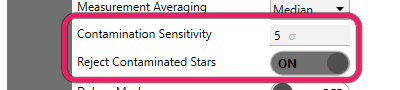
Contamination Sensitivity sets the test strength; Reject Contaminated Stars chooses whether to drop or just flag them.
Settings at a glance
| Setting | Default | Range | Effect |
|---|---|---|---|
| Contamination Sensitivity | 5.0 σ | 0–20 (0 disables) | Required one-sided asymmetry, in multiples of the per-star background scatter, before a star is flagged. Higher = fewer flags. |
| Reject Contaminated Stars | On | On / Off | On removes flagged stars from the result; Off keeps them and only marks them. |
These are Advanced-mode options. In Simple mode the preset derivation never overrides them, so they keep whatever value you (or a reset) last set (for most users, the defaults above).
How the gradient-robust test works
For each candidate the detector samples the pixels in a ring (the background annulus) around the star and fits a robust background plane \( b_0 + b_1\,dx + b_2\,dy \) to them by iteratively reweighted least squares (Huber weighting). That plane is the key idea: a smooth one-sided gradient (the limb of a galaxy, a nebula edge, vignetting) is absorbed into \(b_1\) and \(b_2\) and subtracted away, so it cannot masquerade as contamination.
The fitted plane is then evaluated per pixel and doubles as the local background used for the star's centroid, flux, HFR, and PSF, so a gradient no longer biases any measurement. On a flat field the plane equals the annulus level and nothing changes.
After subtracting the plane, the residuals are binned into 8 octants around the star. The detector computes the median residual in each octant and its standard error \( \mathrm{se} = 1.2533\,\sigma_{\text{local}} / \sqrt{N} \), where \(\sigma_{\text{local}}\) is the robust scatter of the residuals measured from that star's own annulus. A star is flagged when any single octant shows a one-sided positive excess:
Two design choices make this specific to real contaminants. The test is one-sided and positive (a contaminant only adds light), so an edge-clip deficit on one side never trips it. And it acts per octant, so the localized glow of a neighbor is caught while the smooth, all-around gradient (already removed by the plane) is ignored. An octant needs at least 8 residual pixels to be considered.
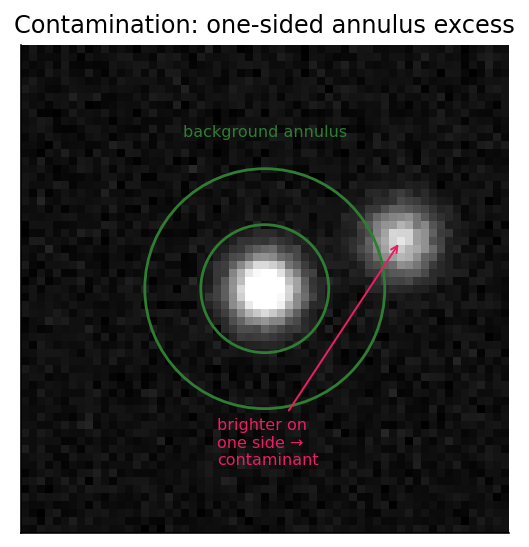 One octant of the background annulus is brighter than the robust plane predicts, the
signature of a nearby star. The plane fit removes any smooth gradient first, so only this
localized, one-sided excess remains to trip the test.
What a flagged star means
Flagging records the star's bounding box (so the annotator can still draw it) and sets a "contamination suspected" marker. Whether the star is then dropped or kept is decided entirely by Reject Contaminated Stars below.
Contamination Sensitivity
Sets how large the one-sided asymmetry must be, in sigma, before a star is flagged.
How aggressively to flag stars whose background annulus is brighter on one side — a sign of a nearby star, hot column, or steep gradient. Value is the required asymmetry in multiples of the local background scatter (measured per star from the annulus itself); higher = fewer flags; 0 disables. Default 5.
Default: 5.0 σ • Range: 0 to 20 (UI field is in σ; values below 0 are clamped to 0, and 0 disables the test entirely)
Because the threshold is in multiples of each star's own annulus scatter, it adapts automatically to bright and faint stars and to noisy versus clean frames: the σ is measured per star, not assumed globally.
When to adjust
- Lower it (e.g. 3–4) when you image dense fields, clusters, or galaxy/nebula regions where close pairs are common and you want HFR and PSF statistics scrubbed of every contaminated star. More stars get flagged. Watch the Contaminated rejection count in the Star Detection Results panel climb as you lower it (or, with rejection off, the contaminated annotation count).
- Leave it at 5 for typical wide-to-medium fields. This is the validated default and balances rejecting genuine contaminants against keeping good stars.
- Raise it (e.g. 8–12) in sparse fields if you find the test is flagging real, isolated stars and you want only the most blatant contaminants caught.
- Set it to 0 to switch the flagging decision off completely. The plane is still fit and still used as the local background, so measurements stay gradient-corrected. You only lose the contamination flag itself.
- Can hurt when set too low on star-poor frames: over-flagging combined with rejection (below) can thin out your usable star list and weaken the focus measurement.
Reject Contaminated Stars
Decides whether a flagged star is removed from the result or kept and only marked.
When enabled (default), stars flagged as contaminated are rejected outright so their one-sided contamination does not skew HFR and PSF statistics. When disabled, contaminated stars are kept and only flagged. A smooth one-sided background gradient (galaxy/nebula) is removed before the test, so only genuine localized contaminants trip it.
Default: On • Range: On / Off
When on, a flagged star is dropped via the Contaminated rejection gate and never enters the HFR/PSF aggregation. When off, the same star stays in the detected set carrying its "contamination suspected" marker, useful for inspection and for the labeling/diagnostic tools, which keep flagged stars so they can be analyzed.
When to adjust
- Leave it on for normal autofocus and HFR work. Removing contaminated stars keeps the focus curve and PSF statistics clean, which is the whole point of the test; with reject on, the count appears under Contaminated in the Star Detection Results panel, whereas with reject off the same stars stay accepted and show only the flagged/contaminated annotation.
- Turn it off when you want to see which stars are suspect rather than lose them, for example while diagnosing why a frame is short on stars, or when feeding frames to the review/diagnostic tooling. It is also the safe choice in very sparse fields where you cannot afford to drop borderline stars.
- Can hurt when left on together with a low Contamination Sensitivity in a star-poor frame: the two compound, and you may reject enough stars to undermine the fit. If that happens, raise the sensitivity or switch to flag-only first.
Not a substitute for clean candidate selection
This test runs on stars that already passed the other acceptance gates; it specifically targets one-sided background excess. Broad problems (saturation, distortion, hot pixels) are handled by their own settings, not here.