Acceptance Gates
Once the structure-detection stage has produced a list of candidate bounding boxes, every candidate must pass a sequence of per-star quality gates before it is accepted into the measured-star set. Each gate guards against a specific kind of false positive: a hot pixel, a noisy clump, a diffraction spike, a clipped star at the image edge, a faint blob indistinguishable from background, or a contaminated neighbor. When a gate rejects a candidate it tags it with a rejection reason you can see in the star-detection metrics panel and the annotated overlay.
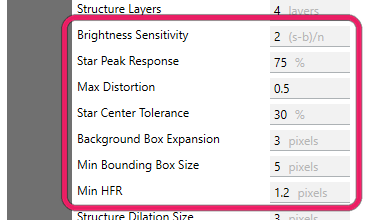
The acceptance gates: brightness sensitivity, peak response, distortion, centering, box size, and minimum HFR.
This page documents the gates exposed as Advanced star-detection options. They run in a fixed order, and a candidate is discarded by the first gate it fails:
- Too Small:
MinStarBoundingBoxSize - On Border (candidate touches the image edge; not user-tunable)
- Too Distorted:
MaxDistortion - Degenerate (parameters could not be computed; not user-tunable)
- Low Sensitivity:
BrightnessSensitivity - Not Centered:
StarCenterTolerance - Too Flat:
StarPeakResponse - HFR analysis failed / Too Low HFR:
MinHFR - Contaminated: see Contamination
StarBackgroundBoxExpansion is not itself a gate, but it controls the local-background estimate that several gates depend on, so it is documented here too. The Defocus-Aware Gates group relaxes the distortion and centering gates for heavily out-of-focus frames, and is covered in its own section at the end.
Note
These settings live under Advanced star detection. In Simple mode they are derived for you from the noise level, pixel scale, and focus-range presets, and the values below are what those presets resolve to. If you have run the Optimization Wizard, a curated subset of these gates is what it tunes.
Settings at a glance
| Setting | Default | Range | Effect |
|---|---|---|---|
| Brightness Sensitivity | 10.0 | ≥ 0 | Minimum signal-to-noise \((s-b)/n\); rejects faint candidates as Low Sensitivity |
| Star Peak Response | 0.75 (75%) | 0–100% | Max median/peak ratio; rejects flat blobs as Too Flat |
| Max Distortion | 0.5 | 0–1 | Min fill ratio of the bounding box; rejects stringy shapes as Too Distorted |
| Star Center Tolerance | 0.3 (30%) | 0–100% | Centered sub-box the centroid must fall in; rejects off-center candidates as Not Centered |
| Min Bounding Box Size | 5 px | ≥ 1 | Smallest allowed candidate side; rejects tiny structures as Too Small |
| Min HFR | 1.2 px | > 0 | Smallest viable Half-Flux Radius; rejects hot-pixel-like spikes as Too Low HFR |
| Background Box Expansion | 3 px | ≥ 1 | Annulus width for the local-background estimate |
| Defocus-Aware Gates | Off | on/off | Relaxes distortion + centering for large (defocused) candidates, but the Defocus-Aware Donut Detection master toggle is what switches that relaxation on; this toggle changes nothing on its own |
| Defocus Size Reference | 30 px | 1–1000 | Size at/below which strict thresholds still apply |
| Defocus Distortion Min Factor | 0.25 | 0.01–1 | Most permissive distortion multiplier for huge donuts |
| Defocus Centering Tolerance Factor | 2.0 | 1–10 | Most permissive centering multiplier for huge donuts |
Brightness Sensitivity
Rejects candidates whose signal does not rise far enough above the local background noise (the Low Sensitivity rejection reason).
Given a star with a normalized brightness measure of s, a local background of b, and a background noise level of n, star sensitivity is measured as the ratio of the star brightness above the background relative to the background noise (s-b)/n. The noise level n is measured on the image actually used for star measurement, so this value is an honest multiple of the real noise and means the same thing regardless of noise-reduction settings. The default of 2 works well; if you find a large number of rejections due to low sensitivity, smaller values increase sensitivity
A candidate is accepted only when its brightness above background divided by the measurement-image noise \(n\) exceeds this threshold, so the gate is a signal-to-noise floor:
Smaller values are more sensitive (they admit fainter stars); larger values are stricter. Because \(n\) is measured on the image actually sampled for star measurement, the same threshold keeps its meaning whether or not noise reduction is enabled.
Default: 10.0. Range: ≥ 0 (must be non-negative)
The tooltip's default of 2 is out of date
The in-app tooltip quoted above still says the default is 2. The shipped default is 10.0, and Simple mode adds 2.0 for the Wide Range focus range and another 2.0 for the Long Focal Length pixel scale (so 12.0 with either, 14.0 with both). Trust the value in the field, not the tooltip.
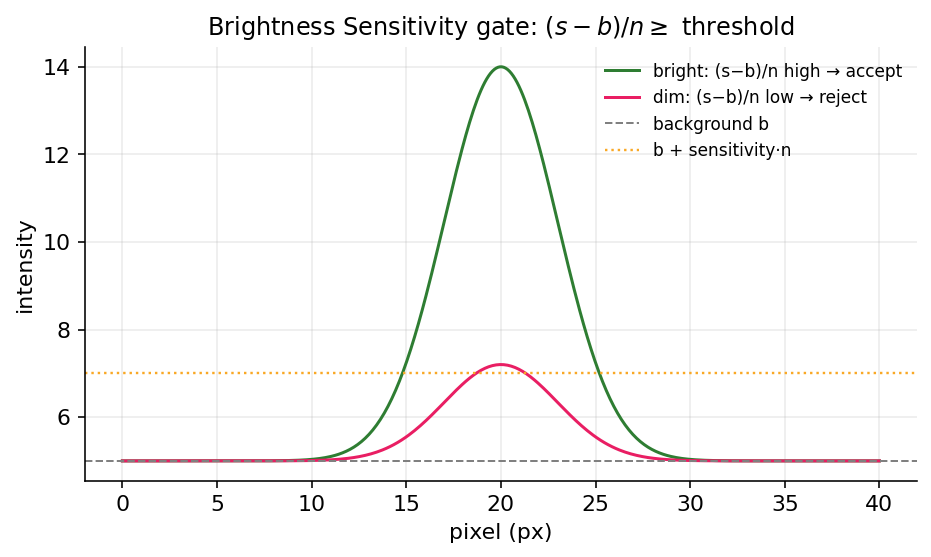 Sensitivity is the star's brightness above background relative to the noise; a dim star with low \((s-b)/n\) is rejected.
When to adjust
Lower it if too many real but faint stars are reported as Low Sensitivity (watch the Low Sensitivity count in the Star Detection Results panel) and your autofocus runs are starved for stars. If the Optimization Wizard lands this setting at or below 1.0, its Summary page shows a Star signal block recommending a longer exposure instead of a lower gate; see Exposure recommendation. Raise it on noisy data where spurious faint blobs are slipping through. It can hurt by flooding detection with noise clumps if set too low, or by discarding usable faint stars near focus if set too high. Leave it at the default for typical data.
Star Peak Response
Rejects candidates that are too flat to be a real star. The rejection reason is Too Flat.
The ratio of the star median relative to the star peak. It provides a measure of flatness, since median values close to the peak indicate low dispersion. Consider increasing if too many stars are rejected with "Too Flat"
A real star is sharply peaked, so its median pixel value sits well below its peak. A flat structure (a wide diffuse blob, a saturated plateau, part of a nebula) has a median close to its peak. The gate rejects a candidate when
The option is shown as a percentage (default 75%), so a candidate fails when its median exceeds 75% of its peak.
Default: 0.75 (75%). Range: 0–100% (must be positive)
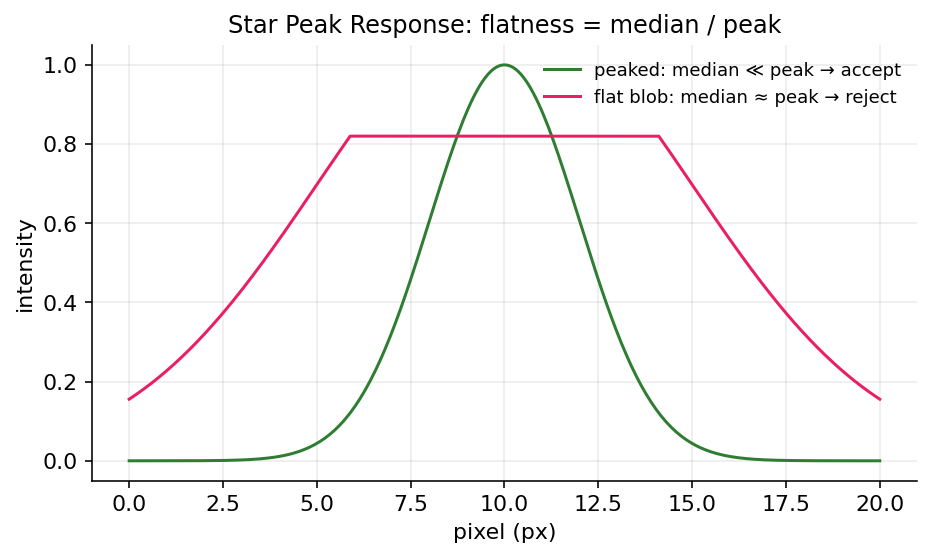 A genuine star has a median far below its peak; a flat blob's median sits close to the peak and is rejected.
When to adjust
Increase it if legitimate stars (often slightly defocused or undersampled ones) are wrongly rejected as Too Flat (check the Too Flat count in the Star Detection Results panel). Leave it at the default for in-focus data. Setting it too high weakens the gate and lets diffuse, non-stellar structure through.
Max Distortion
Rejects candidates whose pixels do not fill their bounding box compactly enough, tagging them Too Distorted. The field is labeled Max Distortion (min fill ratio) in the advanced list.
A MINIMUM fill ratio, despite the name: the ratio of star pixels to the area of the bounding box, where a candidate is rejected as Too Distorted when its fill ratio falls BELOW this value. Raising it makes the gate stricter, not looser. A perfectly round star fills PI/4, approximately 0.785, so values above that reject every round star. The default of 0.5 allows for some distortion and measurement error and should work for most cases.
This is a fill ratio: the number of structure pixels divided by \(d^2\), where \(d\) is the larger of the bounding-box width and height. A perfectly round star fills about \(\pi/4 \approx 0.79\) of its square box. Elongated or stringy shapes (diffraction spikes, satellite trails, merged double stars, hot columns) fill much less and are rejected when
Smaller values are more tolerant of distortion. The default of 0.5 leaves headroom below the ideal disk value for genuine optical aberration and measurement error.
Default: 0.5. Range: 0–1 (must be within [0, 1])
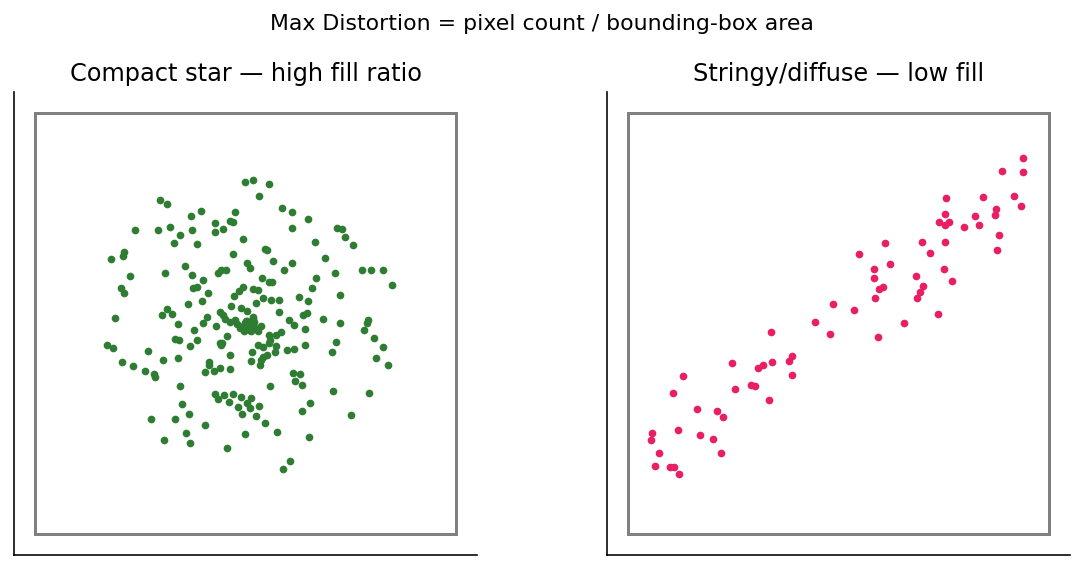 Fill ratio is pixel count over the square box area; a compact star passes while a stringy shape fails.
When to adjust
Lower it if real stars with elongation (from tilt, coma, field curvature, or tracking error) are being rejected as Too Distorted (watch the Too Distorted count in the Star Detection Results panel). Raise it toward the \(\pi/4\) ideal only on excellent optics where you want to suppress trails and spikes aggressively; that risks discarding stars in the corners of a tilted or curved field. For heavily defocused frames, prefer the Defocus-Aware Gates below over lowering this value, since that keeps near-focus frames strict.
Star Center Tolerance
Rejects candidates whose measured centroid is too far from the center of the bounding box (the Not Centered rejection reason).
Size (as a percentage) of a centered rectangle within the star bounding box that the star center must be in. 1.0 covers the whole region, and 0.0 will fail every star
The gate defines a centered sub-rectangle within the bounding box and requires the intensity-weighted centroid to fall inside it. A value of 100% covers the whole box (effectively disabling the check), while 0% would fail every star. This catches candidates where the apparent peak is offset: blends, partially-clipped stars, or a structure pixel-set that is really two sources.
Default: 0.3 (30%). Range: 0–100% (must be positive and ≤ 1.0)
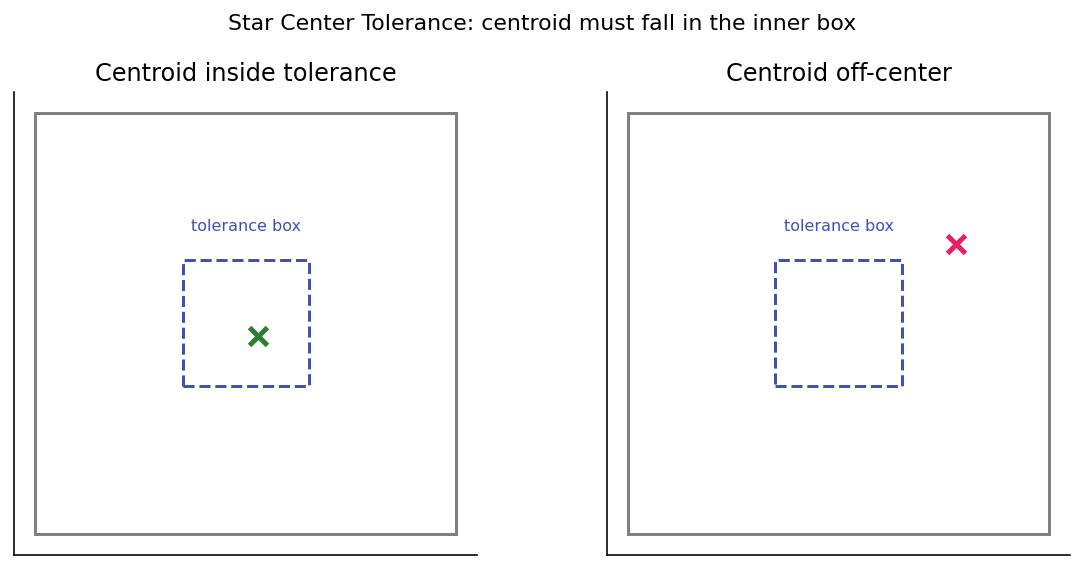 The centroid must fall inside the centered acceptance sub-box; an off-center centroid is rejected.
When to adjust
Raise it (toward 50%) if well-formed stars are rejected as Not Centered (track the Not Centered count in the Star Detection Results panel), which is common with asymmetric aberration or undersampled centroids. Leave the default for typical fields. Setting it too high lets genuinely off-center blends and double stars through. As with distortion, for far-from-focus donut stars the Defocus-Aware Gates relax this automatically for large candidates only.
Min Bounding Box Size
Rejects candidates whose bounding box is smaller than this on either side, flagged as Too Small.
The minimum allowed size (length of either side) of a star candidate's bounding box. Increasing this can be helpful at very high focal lengths if too many small structures are detected
This is the first gate applied. It removes tiny detections (single hot pixels that survived filtering, cosmic-ray hits, and noise specks) that are too small to be a resolved star.
Default: 5 px. Range: ≥ 1 (must be at least 1)
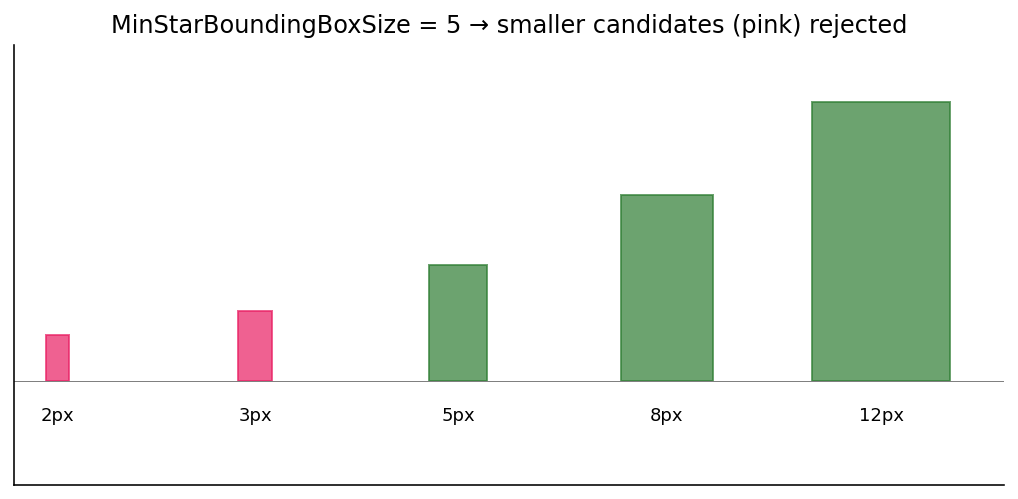 Candidates smaller than the minimum box size on either side are rejected as Too Small.
Starting point
From your rig: MinStarBoundingBoxSize ≈ max(3, round(2–3 × FWHM_px)), where FWHM_px = FWHM_arcsec / pixelScale. This is just a starting point the Simple presets and the optimizer refine.
When to adjust
Increase it at very long focal lengths, where the plate scale spreads real stars over many pixels and small structures are almost always artifacts. Lower it for wide-field, undersampled rigs where genuine stars occupy only a few pixels. Too high a value there will silently drop real stars (and inflate the Too Small count in the Star Detection Results panel). The Simple-mode presets already nudge this down for wide-field and up for long focal length.
Min HFR
Rejects candidates whose measured Half-Flux Radius is at or below this floor. Such candidates are reported as Too Low HFR.
Minimum HFR for a star to be considered viable
A star's HFR is the radius enclosing half its total flux (see Star detection). An impossibly small HFR indicates a point-like artifact (a residual hot pixel or single-pixel spike) rather than a focused star, which always has a finite, optics-limited width. The gate runs late, after HFR has actually been measured, and rejects when \(\text{HFR} \le \text{MinHFR}\).
Default: 1.2 px. Range: > 0 (the backing property accepts 0, but the UI field requires a value greater than zero)
When to adjust
Leave it at the default for almost all setups. Lower it only if you are extremely undersampled and confident your real stars measure below 1.2 px. Raising it discards the sharpest stars and is rarely useful. The default of 1.2 is calibrated to the current measurement pipeline; older versions defaulted to 1.5, which compensated for noise-inflated HFR measurements of faint stars and is no longer needed.
Background Box Expansion
Sets how far outside each candidate's bounding box the local background is sampled. This is not a gate, but the background estimate it produces feeds the sensitivity, flatness, and HFR measurements above, so it indirectly affects those gates.
The background is estimated by looking in an area around the star bounding box, increased on each side by this number of pixels. The default value of 3 should work for most cases, but you can consider increasing it if stars are very spare, or even decreasing it if the star field is very crowded with stars less than 3 pixels from one another.
The detector fits a robust local background plane to the annulus of pixels just outside the bounding box; this expansion sets the annulus width. A wider annulus gives a more stable background but risks including neighboring stars in crowded fields.
Default: 3 px. Range: ≥ 1 (must be at least 1)
When to adjust
Increase it for sparse fields where you want a steadier background estimate. Decrease it in very crowded fields where neighbors sit within a few pixels of each other and would otherwise pollute the annulus. Leave the default for typical star fields.
Defocus-Aware Gates
A toggle that relaxes both the Max Distortion and Star Center Tolerance gates for large candidates, which act as a proxy for heavy defocus. It is off by default. What actually switches the two relaxations on is the Defocus-Aware Donut Detection master toggle described further down this page: with the master off neither relaxation runs, whatever this toggle says, and detection is bit-identical to the strict gates; with the master on both run whether or not this toggle is ticked. The three numeric knobs below are what change how far the relaxation goes.
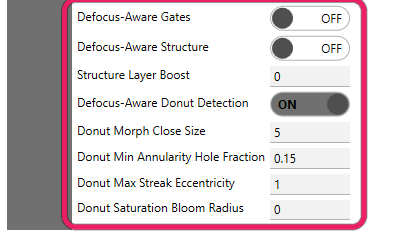
The defocus-aware options and donut-recovery controls sit at the end of the advanced list.
When enabled, both the Max Distortion and Star Center Tolerance gates are relaxed for large candidates (a proxy for large defocus). At large defocus a star becomes a hollow donut (the central-obstruction shadow): it has a big bounding box with a low pixel fill-ratio (which the strict Max Distortion would wrongly reject as too distorted) and a wobbly intensity-weighted center (which the strict centering test would wrongly reject as not centered). Small candidates (near focus) keep the strict thresholds, so junk is still rejected. Off by default; enable it if you collect autofocus frames far from focus and find defocused donut stars being dropped. The three Defocus-Aware tuning values below take effect only while this is enabled.
Why it exists. Far from focus, a star with a central obstruction becomes a hollow donut: a large bounding box with low fill ratio (so the strict Max Distortion rejects it as Too Distorted) and a hollow ring whose intensity-weighted centroid wobbles off-center (so the strict Star Center Tolerance rejects it as Not Centered). Those are exactly the frames at the ends of a wide autofocus sweep, where losing stars hurts the V-curve fit the most.
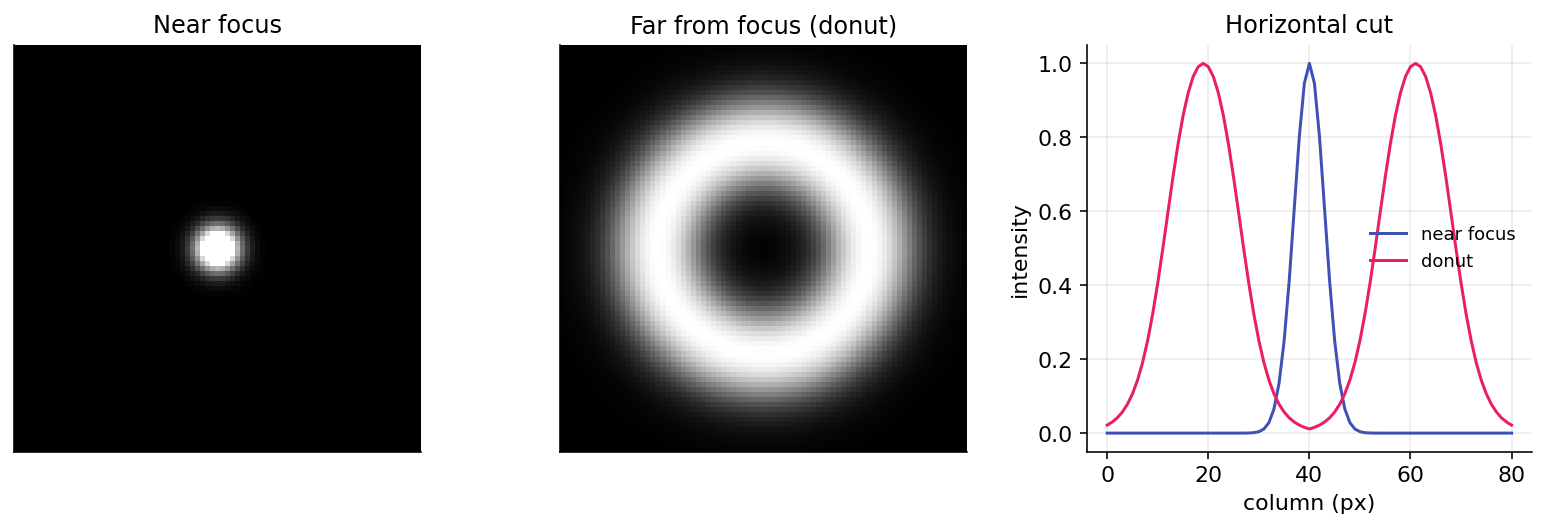 Heavy defocus turns a star into a hollow donut (large box, low fill ratio, unstable centroid) that the strict gates reject.
How the relaxation works. The candidate size used as the defocus proxy is \(d = \max(\text{box width}, \text{box height})\). Candidates at or below the Defocus Size Reference keep the strict thresholds; larger candidates are relaxed progressively:
-
Distortion: the effective fill-ratio threshold is
\[ \text{MaxDistortion} \times \operatorname{clamp}\!\left(\frac{\text{SizeReference}}{d},\ \text{MinFactor},\ 1.0\right), \]so a bigger donut needs to fill proportionally less of its box, floored at
MinFactor × MaxDistortion. -
Centering: the effective tolerance is
\[ \text{StarCenterTolerance} \times \operatorname{clamp}\!\left(\frac{d}{\text{SizeReference}},\ 1.0,\ \text{ToleranceFactor}\right), \]additionally capped at 1.0 (the sub-box covering the whole bounding box), so a bigger donut gets a larger centered acceptance region.
Stars admitted only by the relaxation are flagged internally so the optimizer can discourage over-relaxing into false positives.
When this helps
Enable the Defocus-Aware Donut Detection master toggle when you deliberately collect autofocus frames far from focus (wide sweeps) and see donut stars dropped as Too Distorted or Not Centered at the sweep extremes. That is what puts this relaxation into effect, and it only loosens the two gates for large candidates. It does nothing for near-focus imaging frames, and it should stay off there so the strict gates keep filtering noise. If even heavily defocused stars never appear as candidates at all (not merely rejected), that is a structure-detection problem, not a gate problem; see Defocus-Aware Structure on the Structure detection page.
Defocus Size Reference
Tuning knob for the Defocus-Aware Gates (only used while they are enabled). The candidate bounding-box size (in pixels, the larger of width/height) at or below which the strict gate thresholds still apply; larger candidates get the relaxed thresholds. Shared by both the distortion and centering relaxations. Lower it to relax smaller stars; raise it to keep more of the strict behavior. Default 30.
Default: 30 px. Range: 1–1000
Lower it to begin relaxing at smaller candidate sizes (recovers slightly-smaller donuts, at the cost of relaxing moderately-defocused frames); raise it to keep more of the strict behavior. The default of 30 px was tuned so the most-defocused donuts clear the gates while the nearest in-sweep frames keep the strict thresholds and do not flood with false detections.
Defocus Distortion Min Factor
Tuning knob for the Defocus-Aware Gates (only used while they are enabled). The floor multiplier applied to Max Distortion for very large (very defocused) candidates — the most permissive the distortion gate ever becomes. Must be greater than 0 and at most 1. Smaller values accept more heavily-distorted donuts. Default 0.25.
Default: 0.25. Range: 0.01–1
This is the lowest the effective fill-ratio threshold can ever drop to, expressed as a fraction of Max Distortion. Smaller values admit more heavily distorted donuts; 1.0 disables the distortion relaxation entirely (the gate stays strict regardless of size).
Defocus Centering Tolerance Factor
Tuning knob for the Defocus-Aware Gates (only used while they are enabled). The maximum multiplier applied to Star Center Tolerance for very large (very defocused) candidates — the most permissive the centering gate ever becomes. Must be at least 1 (1 is a no-op; larger values relax centering further). Default 2.
Default: 2.0. Range: 1–10
The most the centering tolerance can be multiplied by for the largest candidates. A value of 1 is a no-op (centering stays strict); 2 doubles the centered acceptance sub-box for fully-defocused donuts. The effective tolerance is always capped at 1.0 (the whole bounding box), so very large factors saturate rather than overshoot.
Recover Out-of-Focus Donut Stars
A second, separate opt-in feature aimed at the same problem the Defocus-Aware Gates address (heavily defocused stars), but from the structure/shape side rather than by loosening thresholds. It is a single master toggle, Defocus-Aware Donut Detection, that is off by default; when off, detection is bit-identical to having the feature absent. It also appears on the Optimization Wizard's start page as "Recover out-of-focus donut stars (reflectors/SCTs)".
On a heavily defocused frame from a central-obstruction scope, recovering donuts needs both this group and a low noise-clipping floor: the floor forms the ring candidates, and these gates keep them. See Donut-Aware Settings for the measured "both levers" result.
MASTER toggle for defocus-aware donut detection (also on the optimizer wizard's start page). When ON, out-of-focus DONUT stars (heavily defocused stars that appear as hollow rings) are recovered: a morphological close reconnects fragmented rings and an annularity test lets a hollow ring pass the distortion gate like a filled disk (detection-only — it never changes HFR). It also unlocks the optimizer to tune ALL defocus-aware settings and to enable diffraction-spike / saturated-bloom suppression. Recommended for telescopes with a central obstruction (Newtonians/SCTs); leave OFF for refractors. Off by default; when OFF, detection is exactly as before.
What it does. A heavily defocused star with a central obstruction breaks up into a fragmented hollow ring. Two things go wrong: the arcs of the ring are detected as several tiny structures (each dropped as Too Small), and even when the ring is whole its hollow center gives it a low fill ratio that the strict Max Distortion gate rejects. This feature fixes both. A morphological close reconnects the ring arcs into one candidate, and an annularity test recognizes a genuine hollow ring and lets it through the distortion gate as if its hole were filled. The recovery is detection-only: it changes which candidates survive, never the measured HFR, flux, or center.
Which donut feature do I need?
- If donuts are rejected as Too Distorted or Not Centered, the Defocus-Aware Gates above relax those gates for large candidates.
- If donuts never form a candidate at all (fragmented into Too Small pieces, or erased before candidate formation), this Donut Detection group reconnects them, and the Defocus-Aware Structure option keeps very large donuts from being wiped out by background removal in the first place.
- The three features are complementary; the optimizer can enable and tune them together once the master toggle is on.
These five settings live under Advanced star detection, and the four numeric knobs below take effect only while the master toggle is on.
| Setting | Default | Range | Effect |
|---|---|---|---|
| Defocus-Aware Donut Detection | Off | on/off | Master toggle for the whole group; off ⇒ detection bit-identical |
| Donut Morph Close Size | 5 | 1–25 px | Kernel diameter that reconnects fragmented ring arcs into one candidate (1 = no close) |
| Donut Min Annularity Hole Fraction | 0.15 | 0.02–0.6 | Minimum enclosed dark center (fraction of box area) for a hollow ring to be treated like a filled disk by the distortion gate |
| Donut Max Streak Eccentricity | 1.0 | 0.8–1.0 | Rejects very linear candidates (diffraction spikes, trails) at/above this eccentricity; 1.0 = off |
| Donut Saturation Bloom Radius | 0.0 | 0–100 px | Rejects candidates whose center lies within this many pixels of a saturated star (bloom fragments); 0 = off |
Donut Morph Close Size
Only used while Defocus-Aware Donut Detection is on. Diameter (px) of the morphological-close kernel that reconnects fragmented donut-ring arcs into one candidate (the dominant cause of donuts being dropped as 'too small'). 1 means no close. Keep it smaller than the gap between a bright star's diffraction spikes so it doesn't bridge them. EARLY-stage setting. Default 5.
Default: 5 px. Range: 1–25. This is an EARLY-stage parameter (it changes candidate formation). Raise it if donut arcs are still detected as separate fragments; keep it below the spacing of a bright star's diffraction spikes so the close does not bridge them into one blob.
Donut Min Annularity Hole Fraction
Only used while Defocus-Aware Donut Detection is on. Minimum size of a candidate's enclosed dark center (as a fraction of its bounding-box area) for it to count as a donut whose hole is filled for the distortion test — so a hollow ring is judged like a filled disk. This is detection-only and never changes the measured HFR/flux/center. Lower it to accept thinner rings; raise it to be stricter. Default 0.15.
Default: 0.15. Range: 0.02–0.6. Lower it to accept thinner rings (smaller holes); raise it to be stricter about what counts as a true donut.
Donut Max Streak Eccentricity
Only used while Defocus-Aware Donut Detection is on. Rejects very LINEAR candidates (diffraction spikes from a bright star, or satellite/aircraft trails) when their elongation (eccentricity) meets or exceeds this value. 1.0 means OFF (a perfect line has eccentricity 1.0, so nothing is rejected); lower it toward 0.95 to enable. Round donuts measure well below this, so they are never affected. Default 1.0 (OFF — the optimizer enables it when you label false detections).
Default: 1.0 (off). Range: 0.8–1.0. A spike-suppression guard: lower it toward 0.95 to reject diffraction spikes and trails. Round donuts sit well below this, so they are unaffected.
Donut Saturation Bloom Radius
Only used while Defocus-Aware Donut Detection is on. Rejects candidates whose center lies within this many pixels of a saturated star, removing the bloom/halo fragments around a bright saturated star while keeping the star itself. 0 means OFF. Default 0 (OFF — the optimizer enables it when you label the saturated star's artifacts as should-reject).
Default: 0 (off). Range: 0–100 px. Raise it to clear the bloom/halo fragments that ring a bright saturated star while keeping the star itself.
Note
Related rejection reasons (Contaminated for one-sided neighbor light, and the saturation handling) are covered on the Contamination and Hot pixels & saturation pages. For how the optimizer searches over these gates, see Search variables.