Adaptive Binarization
Candidate formation begins by binarizing the structure map at a noise floor: a pixel must rise a set number of noise sigmas above the background to survive as part of a star candidate. That floor is the single biggest lever on recall, because a star that never clears it never becomes a candidate. This page explains how the floor was audited, why the shipped default currently sits back at 4.0, and how the floor was made to vary across the frame.
The shipped default is currently 4.0
The audit below drove the default down from 4.0 to 2.0. That change has since been reverted on an interim basis: the shipped default, the Simple-mode preset, and the optimizer seed all use 4.0 again, pending a recalibration. The measurements below still stand, and 2.0 remains a sensible value to try by hand or to let the Optimization Wizard find for your rig, but it is not what ships today.
The settings
The floor is controlled by three options, all documented in full on Preprocessing:
| Setting | Default | Reference |
|---|---|---|
| Noise Clipping Multiplier | 4.0 | Preprocessing |
| Locally Adaptive Binarization | On | Preprocessing |
| Adaptive Noise Block Size | 128 px | Preprocessing |
From 4 to 2
Candidate formation binarizes the structure map at a floor of \(\text{median} + \text{NoiseClippingMultiplier} \times \sigma_{\text{structure}}\). A lower multiplier pulls the floor down, so fainter structure survives to become a candidate. The multiplier had been 4 ever since Hocus Focus was first released, an inherited default that was never revisited until a golden-set audit measured what it was costing. Sweeping it directly against a golden set isolates its effect:
| NoiseClippingMultiplier | recall @ SNR≥12 | NO CANDIDATE |
precision |
|---|---|---|---|
| 4.0 (legacy) | 0.189 | 6191 | 0.85 |
| 2.5 | 0.358 | 4712 | 0.82 |
| 2.0 (audit setpoint) | 0.459 | 3556 | 0.81 |
| 1.5 | 0.596 | 1757 | 0.80 |
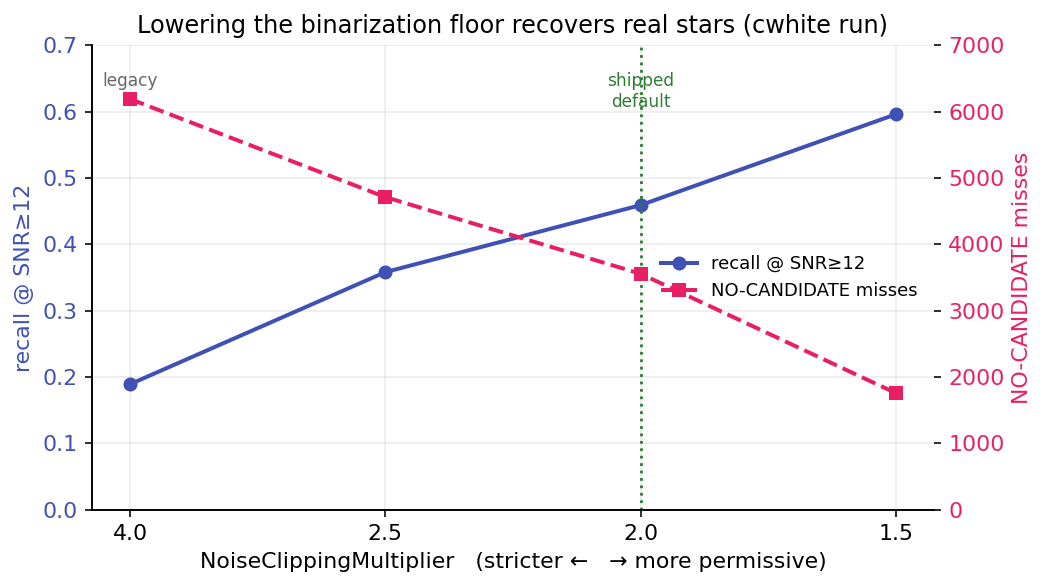
Lowering the floor from 4 to 1.5 triples recall @ SNR≥12 and collapses the NO CANDIDATE misses, at a small
precision cost. The two other candidate-formation knobs, Structure Layers and Min Bounding Box Size, did not
help recall in isolation.
A lower floor admits fainter stars, and fainter stars can carry noisier HFR, so the next question was whether this hurts the focus curve. It does not. The per-region HFR-versus-focuser curve was rebuilt at each multiplier (NC) and parabola-fit for best-focus position and goodness of fit:
| Region | NC = 4 | NC = 2 |
|---|---|---|
| Global | 119 stars, R² 0.96 | 327 stars, R² 0.93 |
| Center | 18 stars, R² 0.93 | 55 stars, R² 0.98 |
| Corners | 3–6 stars (one would not fit at all) | 11–21 stars, R² 0.87–0.99 |
Best-focus position stayed put (global 2719 → 2718, center 2706 → 2706), goodness of fit stayed high, and near-focus HFR scatter rose only about 0.1 px. The corners, which are the most star-starved and which give the tilt fit its leverage, went from too few stars to fit to a usable 11–21. A multiplier of 1.5 adds still more stars but with slightly more corner scatter, so the audit's setpoint landed at 2.0.
Why 2 and not 1.5? Three checks ran independently and agreed across a 17-run bank of saved focus runs:
- Recall @ SNR≥12 rose bank-wide as the multiplier fell, with the median going from 0.797 at NC = 4 to 0.870 at NC = 2.
- On the run with the most complete golden (so its precision is trustworthy), dropping to 2 roughly doubled recall (0.189 → 0.459) for a negligible precision cost (0.849 → 0.811).
- The per-run optimizer, which minimizes focus scatter and is therefore immune to the precision-measurement artifact, converged to a median multiplier of exactly 2.0 (10 of 17 runs), and where it deviated it went lower, never back toward 4.
A single global floor is the wrong shape
A single global multiplier still leaves recall on the table. Recall was still climbing at NC = 2 on the cleanest frames, yet a lower global value floods the noisy corners with false candidates. The reason is that the floor is one scalar applied to a frame that is not uniform. Vignetting, sky gradients, amp glow, and field-edge falloff make the local background and local noise vary by two to four times across a single frame. A global floor is then too high in the clean center, where real faint stars fall below it, and too low in the noisy corners, where noise clears it. Lowering the multiplier trades one failure for the other. It cannot fix both, because the shape of the floor is wrong, not just its level.
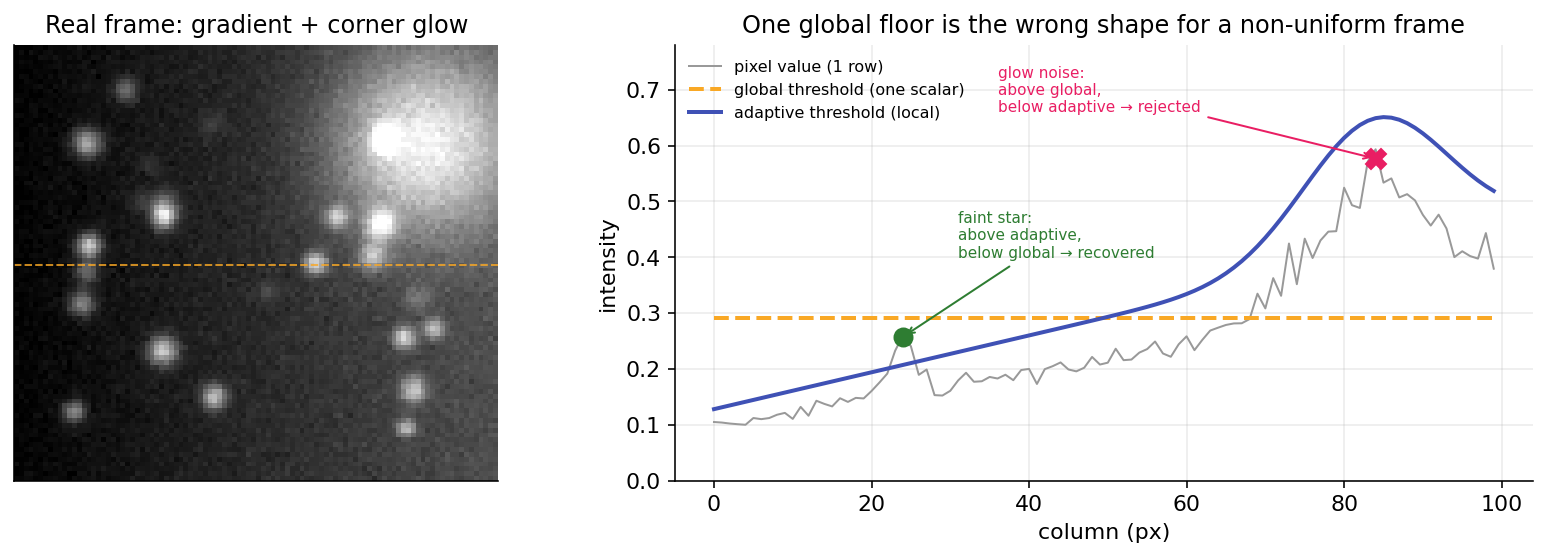
One global floor cannot fit a non-uniform frame. It sits too high over the clean region (missing the faint star on the left) and too low under the corner glow (passing the noise on the right). A floor that tracks the local background and noise gets both right.
Locally adaptive binarization
The fix is the Locally Adaptive Binarization option. Instead of one scalar, the floor becomes a smooth surface computed from robust per-block statistics, \(\text{median}_{\text{local}}(x,y) + \text{NoiseClippingMultiplier} \times \sigma_{\text{local}}(x,y)\), estimated on a coarse grid (128 px blocks by default) and upsampled to the full frame. The multiplier itself is unchanged, but it is now locally fair: low where the background is clean, recovering faint stars, and high where it is noisy, rejecting noise. This is the same local-statistics approach the reference detector uses to define the recall target in the first place.
Tested OFF against ON at NC = 2 across the 17-run bank, the surface improves recall and precision together, which no single global value can do:
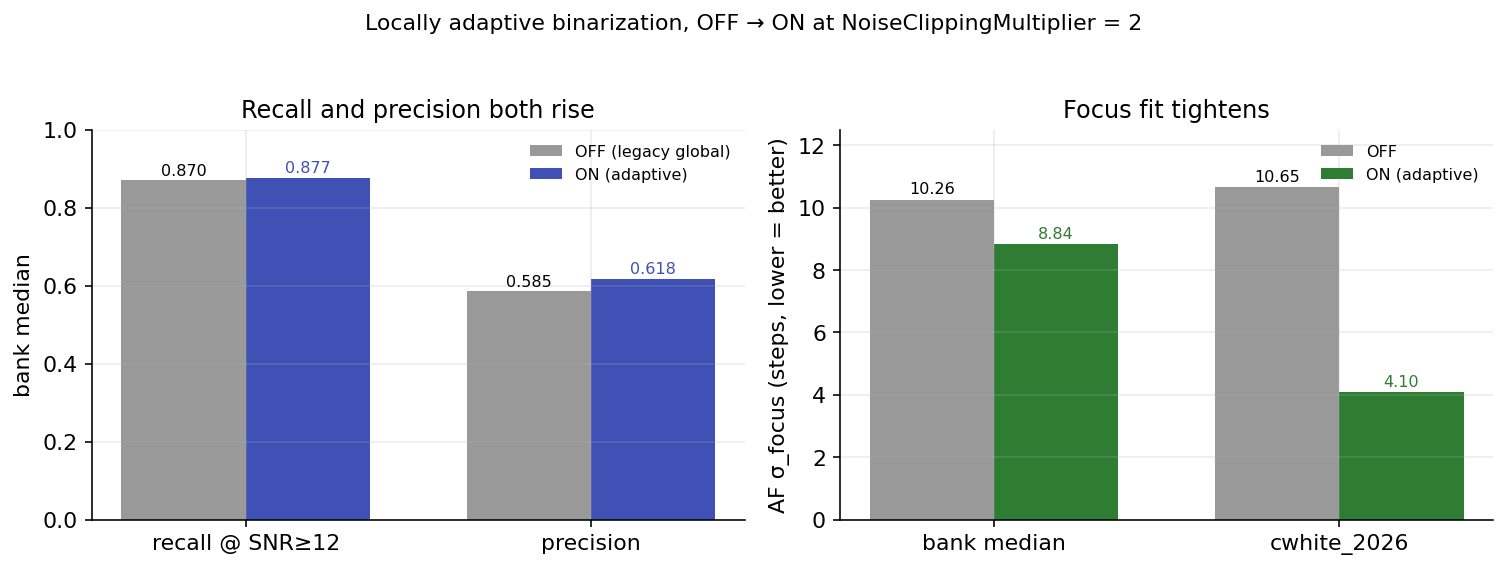
OFF versus ON at NC = 2. Bank-median recall @ SNR≥12 and precision both rise, and the autofocus fit tightens. On the run with the most complete golden, recall jumps from 0.459 to 0.862 and the focus scatter is more than halved.
Because it improves both axes with no autofocus or donut regression, locally adaptive binarization ships on by default. It changes the floor's shape, not its level: whatever multiplier you run, the surface is what makes that multiplier fair everywhere.
Reverting to legacy behavior
The floor's shape and its level are independent:
- Turning Locally Adaptive Binarization off reverts the floor's shape to the legacy single global scalar. With it off, candidate formation is bit-for-bit identical to the pre-change detector.
- The Noise Clipping Multiplier sets the floor's level. It currently ships at the legacy 4.0 (see the warning at the top of this page), so only the shape differs from legacy out of the box.
The only reason to turn the surface off is to reproduce or compare against the old detector. Locally adaptive binarization beat the global floor on every rollout criterion across the bank, improving recall and precision together, so for real use leave it on. If you want the recall the audit above measured, lower the multiplier toward 2.0 yourself or let the Optimization Wizard pick it for your rig.