Donut-Aware Settings
Far from focus, a star with a central obstruction (a Newtonian or an SCT) becomes a hollow donut. The default detector drops most of them, which costs the stars at the ends of a wide autofocus sweep, exactly where the V-curve fit needs them. The opt-in donut-aware features recover those stars. This page explains the settings and the measured data behind adding them. The features are off by default; with all of them off, detection is identical to having them absent.
The settings
All defocus-aware behavior is gated by the Defocus-Aware Donut Detection master toggle. With the master off, Defocus-Aware Gates and Defocus-Aware Structure have no effect and detection is exactly as if the features were absent. With the master on, the distortion and centering relaxations run whether or not Defocus-Aware Gates is ticked, and the wavelet residual is computed two layers coarser unless Defocus-Aware Structure is ticked, in which case Structure Layer Boost sets the extra layers instead. The numeric knobs and their full reference live on the Acceptance Gates and Structure Detection pages:
| Setting | Default | Reference |
|---|---|---|
| Defocus-Aware Donut Detection (master) | Off | Acceptance Gates |
| Defocus-Aware Gates | Off | Acceptance Gates |
| Defocus-Aware Structure + Structure Layer Boost | Off / 0 | Structure Detection |
| Donut Morph Close Size, Donut Min Annularity Hole Fraction, Donut Max Streak Eccentricity, Donut Saturation Bloom Radius | per knob | Acceptance Gates |
The problem
On a heavily defocused frame from a central-obstruction scope, of 279 structure candidates only 43 were accepted. The rejections were dominated by TooSmall (122, because the ring fragments into separate arcs that are each too small) and TooDistorted (99, because a whole hollow ring fails the fill-ratio test). The detector found almost nothing on a donut frame.
What each knob fixes
Each donut knob targets one of those failure modes:
- a wavelet-layer boost so a big donut survives background removal,
- a morphological close that reconnects fragmented ring arcs into one candidate,
- an annularity test that lets a hollow ring pass the distortion gate like a filled disk,
- an integrated-flux sensitivity path so a faint donut is judged on its total ring flux, not its low per-pixel peak,
- distortion and centering relaxation for large candidates only,
- a clip cap so an aggressive per-pixel clip cannot strip a thin ring during measurement,
- optional diffraction-spike and saturation-bloom suppression for the bright stars that defocus alongside the donuts.
The justification
In a controlled headless comparison against a dense by-eye golden set, turning the feature on lifted recall from 0.098 to 0.226 (about 2.3x) with precision essentially perfect (0.992 → 1.000), and per-frame accepted counts on the worst frames rose roughly fourfold. The saturated star's core and diffraction spikes produced no spurious detections.
The key result is that donuts need both levers, the low noise-clipping floor and the donut-aware gates:
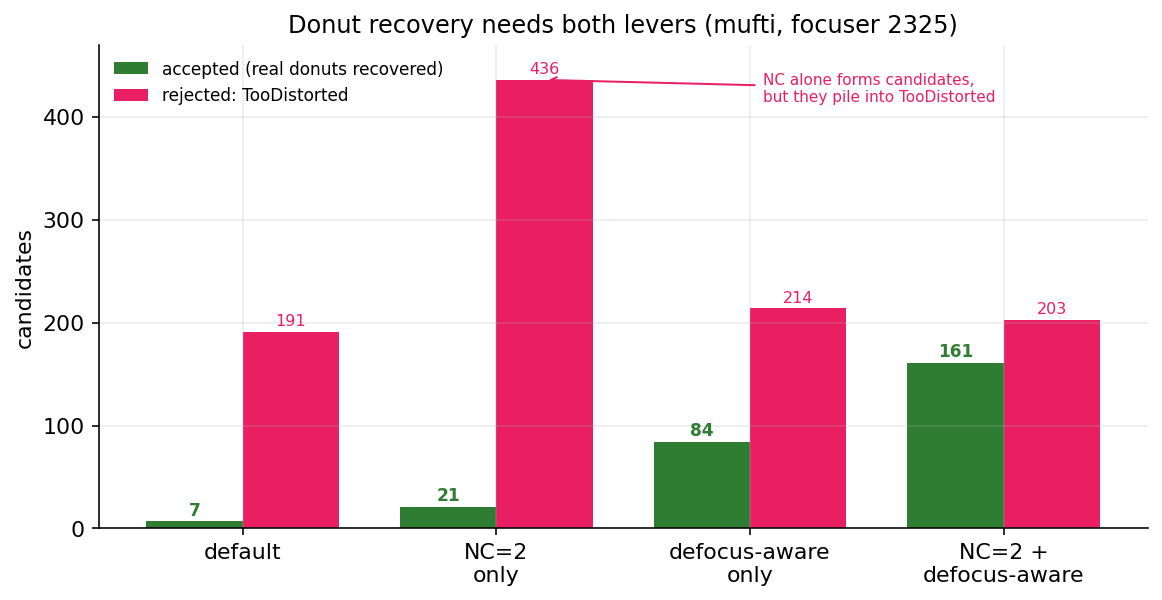
Lowering the floor alone forms more donut candidates, but they pile straight into TooDistorted (191 → 436): the structure stage proposes the rings, then the strict distortion gate throws them out. The defocus-aware gates alone relax that gate but cannot recover rings the strict floor never proposed. Only with both on are 161 stars recovered, 22x the default, at 0.93 precision.
So a donut run wants the low, adaptive floor and the donut-aware gates together, not either alone.
What it does not recover
Faint pure-ring donuts with no core stay noise-limited for any detector. Hocus Focus catches the brighter cored donuts and misses the faint rings, and a naive matched filter over-detects them. When a star is that far out of focus, its ring also carries little usable focus signal.