Search Variables: The Curated Search Space
The optimizer does not tune every star-detection parameter. It tunes a deliberately small, curated set of knobs that have the largest, most predictable effect on the autofocus curve, and it leaves the rest out of the search entirely. Keeping the search space small is what lets a derivative-free search converge inside a fixed evaluation budget (MaxEvaluations = 250 by default, raised to 400 when Recover out-of-focus donut stars is enabled).
This page is the reference for that curated set: every variable, its bounds, the setting it maps to, the two synthetic variables that drive more than one parameter at once, how values are quantized, and the EARLY/LATE split that makes the search fast.
Where the search space comes from
The curated set is defined once, in code, by OptimizerVariable.CreateCuratedSet(). Each entry carries its own [Lower, Upper] bounds and InitialStep, and every proposal the search makes is clamped and quantized through that one descriptor, so the published bounds below are the bounds the optimizer actually obeys.
The curated variables
Each row is one tunable axis. Type governs quantization (see Quantization rules). InitialStep is the starting pattern-search step on that axis; the search halves Continuous steps as it converges down to a floor of InitialStep × 0.125. Maps to is the underlying StarDetectorParams field, which corresponds to a StarDetectionOptions setting.
| Variable | Type | Lower | Upper | InitialStep | Maps to setting |
|---|---|---|---|---|---|
Sensitivity |
Continuous | 0 | 50 | 1.0 | Sensitivity (see acceptance gates) |
StarClippingMultiplier |
Continuous | 0.25 | 10 | 0.5 | Star clipping multiplier |
NoiseClippingMultiplier |
Continuous | 1 | 10 | 0.5 | Noise clipping multiplier (see structure detection) |
PeakResponse |
Continuous | 0.1 | 1 | 0.05 | Peak response / flatness gate (see acceptance gates) |
MaxDistortion |
Continuous | 0.1 | 0.785 (π/4) | 0.1 | Max distortion gate |
MinHFR |
Continuous | 0.1 | 5 | 0.25 | Minimum HFR |
StarCenterTolerance |
Continuous | 0.05 | 1 | 0.05 | Star center tolerance |
StructureLayers |
Integer | 1 | 8 | 1 | Structure layers (see structure detection) |
NoiseReductionRadius |
Integer | 0 | 10 | 1 | Noise reduction radius (see preprocessing) |
MinimumStarBoundingBoxSize |
Integer | 2 | 20 | 1 | Minimum star bounding-box size |
HotpixelThresholdingEnabled |
Boolean | 0 | 1 | — | Hot-pixel thresholding on/off (see hot pixel & saturation) |
HotpixelThreshold |
Continuous | 0.0001 | 0.05 | 0.001 | Hot-pixel threshold |
DefocusAwareGates |
Boolean (synthetic) | 0 | 1 | — | Two gate-relaxation params at once (see below) |
DefocusAwareStructure |
Integer (synthetic) | 0 | 4 | 1 | Defocus-aware structure flag + layer boost (see below) |
Those are the 12 always-on axes. The two synthetic rows in the table above (DefocusAwareGates, DefocusAwareStructure) plus seven further defocus-tuning knobs (DefocusDistortionSizeReference, DefocusDistortionMinFactor, DefocusCenteringToleranceFactor, DonutMorphCloseSize, DonutMinAnnularityHoleFraction, DonutMaxStreakEccentricity, DonutSaturationBloomRadius) are added only when Recover out-of-focus donut stars is enabled, taking the curated set to 21 axes. With that master toggle off (the default) the optimizer never touches any defocus parameter.
Several bounds are open-ended in the detector (there is no hard UI validation range), so the wizard applies pragmatic heuristic limits. Sensitivity was widened from a 20 to a 50 ceiling and StarClippingMultiplier to a [0.25, 10] range because rich star fields kept pinning the older, tighter bounds.
MaxDistortion is the exception: its ceiling is geometric, not heuristic. Despite the name, the setting is a minimum fill ratio, and the gate rejects a candidate whose star pixels fill less of its bounding box than the threshold, so raising it makes the gate stricter (see Max Distortion). A perfectly round star can only reach the fill ratio of a disk inscribed in its own box, π/4 ≈ 0.785, so any threshold above that rejects every round star. The search axis stops there rather than leaving a dead band the pattern search could walk into.
The two highest-impact axes, Sensitivity and StarClippingMultiplier, are also the pair the search grids over first in its coarse Phase A (see search algorithm).
The two synthetic variables
Most axes are a one-to-one alias for a single StarDetectorParams field. Two are synthetic: one variable drives more than one parameter so the optimizer can explore a behavior as a single knob.
DefocusAwareGates (Boolean)
A single on/off switch that flips both defocus-aware gate relaxations (DefocusAwareDistortion and DefocusAwareCentering) in lockstep. When enabled, these gates relax the distortion and centering checks for large candidates (large size is used as a defocus proxy), recovering bloated and donut-shaped defocused stars that the strict gates would reject (see Defocus-Aware Gates).
The variable reads the distortion flag as its value and writes the same value to both flags. Both flags are OFF in the default seed parameters, so the baseline is unchanged, and the search may flip the pair on if it helps the curve.
Why turning the gates on isn't free
Relaxing the gates can also admit large, low-fill junk blobs. The objective guards this with a multiplicative near-focus precision penalty (SDefocusPrecision): it is exactly 1.0 when no relaxation-admitted stars exist (so OFF is bit-identical), and it only bites when a near-focus frame shows a sustained relaxed fraction above 0.20, the junk signature. Legitimate donut recovery on the defocused extremes is never penalized. See the objective function.
DefocusAwareStructure (Integer, 0–4)
A single integer that drives both the DefocusAwareStructure flag and the StructureLayerBoost count. A value of 0 means OFF (the bit-identical baseline); any value > 0 enables defocus-aware structure detection with that many extra wavelet layers, recovering large/donut defocused stars that otherwise never form a candidate at all.
The variable reads the effective boost (0 when the flag is off), so the seed's \(J\) is unchanged; the search may raise it. This knob is structure-side (it changes which candidates are formed), whereas DefocusAwareGates is gate-side (it changes which formed candidates survive).
Quantization rules
Every proposal flows through the variable's descriptor as a double, which is quantized to a legal value of its type and then clamped to [Lower, Upper] before being stored:
- Continuous — identity (any real value in range).
- Integer —
Math.Round(v, AwayFromZero), then clamped. Integer step moves usemax(1, round(step)), so an integer axis always moves by at least 1. - Boolean —
v ≥ 0.5 ? 1 : 0, bounds always[0, 1]. A Boolean move is a flip; only the+direction produces a candidate (the−flip is the same value and is deduplicated).
Because the bounds live in exactly one place per variable and every write re-quantizes through that same descriptor, a proposal can never escape the published range.
EARLY vs LATE — why the split matters
Detection is internally split into a cacheable EARLY context (image preparation, candidate regions, both noise sigmas, early metrics) and a cheap LATE gate-and-measure pass. The optimizer mirrors this split by classifying each curated axis using the detector's single source of truth, StarDetector.IsEarlyCacheKeyParameter:
- EARLY axes feed
BuildDetectionContext. Moving one forces a full re-detect of every frame and evicts the cached early context. The EARLY-keyed curated variables are:NoiseClippingMultiplier,StructureLayers,NoiseReductionRadius,HotpixelThresholdingEnabled,HotpixelThreshold, and, when donut recovery is enabled, the syntheticDefocusAwareStructure(it shares the early cache-key property name) andDonutMorphCloseSize(the early morphological close). - LATE axes are everything else:
Sensitivity,StarClippingMultiplier,PeakResponse,MaxDistortion,MinHFR,StarCenterTolerance,MinimumStarBoundingBoxSize, and, when donut recovery is enabled, the syntheticDefocusAwareGates. A move on a LATE axis is a per-frame cache hit: it reuses the already-built early context and only re-runs the cheap gate/measure stage.
Why this is ~10–13× faster
The staged compass search refines all the cheap LATE axes first (with the EARLY params pinned, so every probe is a cache hit), then runs one bounded EARLY stage, and only revisits EARLY if it keeps improving. This cuts the number of full re-detects versus probing every axis on every sweep, without changing which points are reachable, only the order they're visited. See the search algorithm.
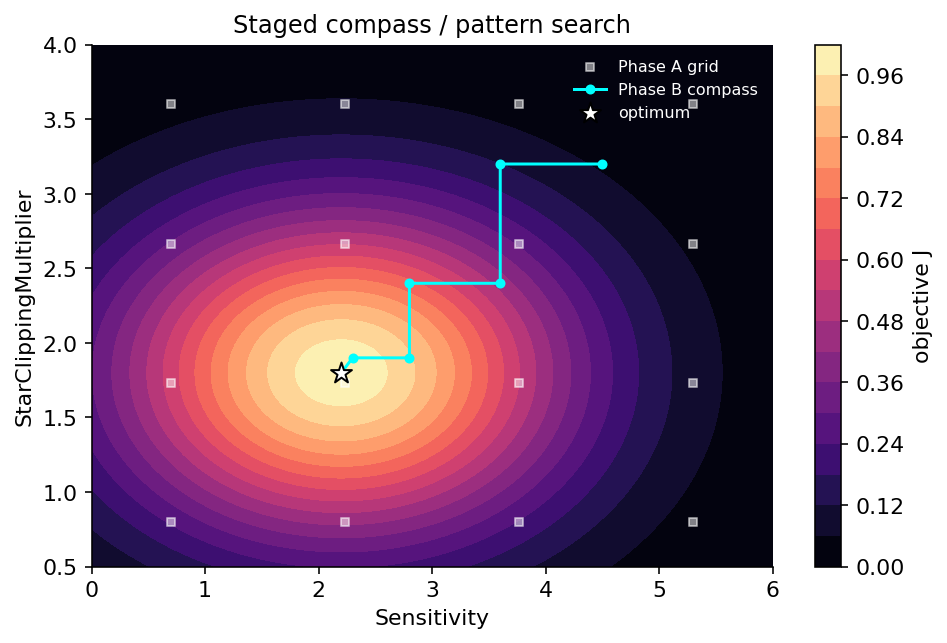
The coarse grid seeds a starting point, then the staged compass search steps along axes (accepting only strictly-improving moves) and halves its step as it homes in.
Bounds are a floor and a ceiling, not a target
The optimizer starts from the seed (the default detection parameters, or your current settings when you choose "Start from my current settings") and only accepts strictly-improving moves, so the result can never score worse than the seed; on top of that, the wizard never hands back a result worse than your current settings (see search algorithm). The bounds above define how far each axis is allowed to travel; rich star fields tend to push Sensitivity and the clipping multipliers toward their upper ends, while sparse fields stay low. If you find an optimized value pinned exactly at a bound, that is a hint the true optimum may lie outside the curated range and the limit (not the data) stopped the search.